10 AI Chatbot Advantages for Businesses and Customers
Shlok Sobti
10 AI Chatbot Advantages for Businesses and Customers
Businesses across industries are adopting AI chatbots to handle everything from customer queries to lead generation, and the results speak for themselves. The ai chatbot advantages go well beyond simple automation; they reshape how companies operate and how customers experience service. Whether it's 24/7 availability or instant multilingual support, chatbots are solving real problems that traditional setups struggle with.
At Invsify, we've seen this firsthand. Our Conversational RM AI helps users navigate wealth management questions, get personalized recommendations, and resolve financial queries, all without waiting on hold or scheduling a call. As a SEBI Registered Investment Advisor, we built our AI chatbot to deliver conflict-free, data-backed guidance at any hour, in multiple languages. That experience gives us a practical lens on what chatbots can actually do when they're designed well.
This article breaks down 10 specific advantages AI chatbots bring to both businesses and customers. You'll find concrete benefits backed by real use cases, not vague promises. If you're evaluating whether a chatbot fits your business or simply want to understand why companies are investing heavily in this technology, you're in the right place.
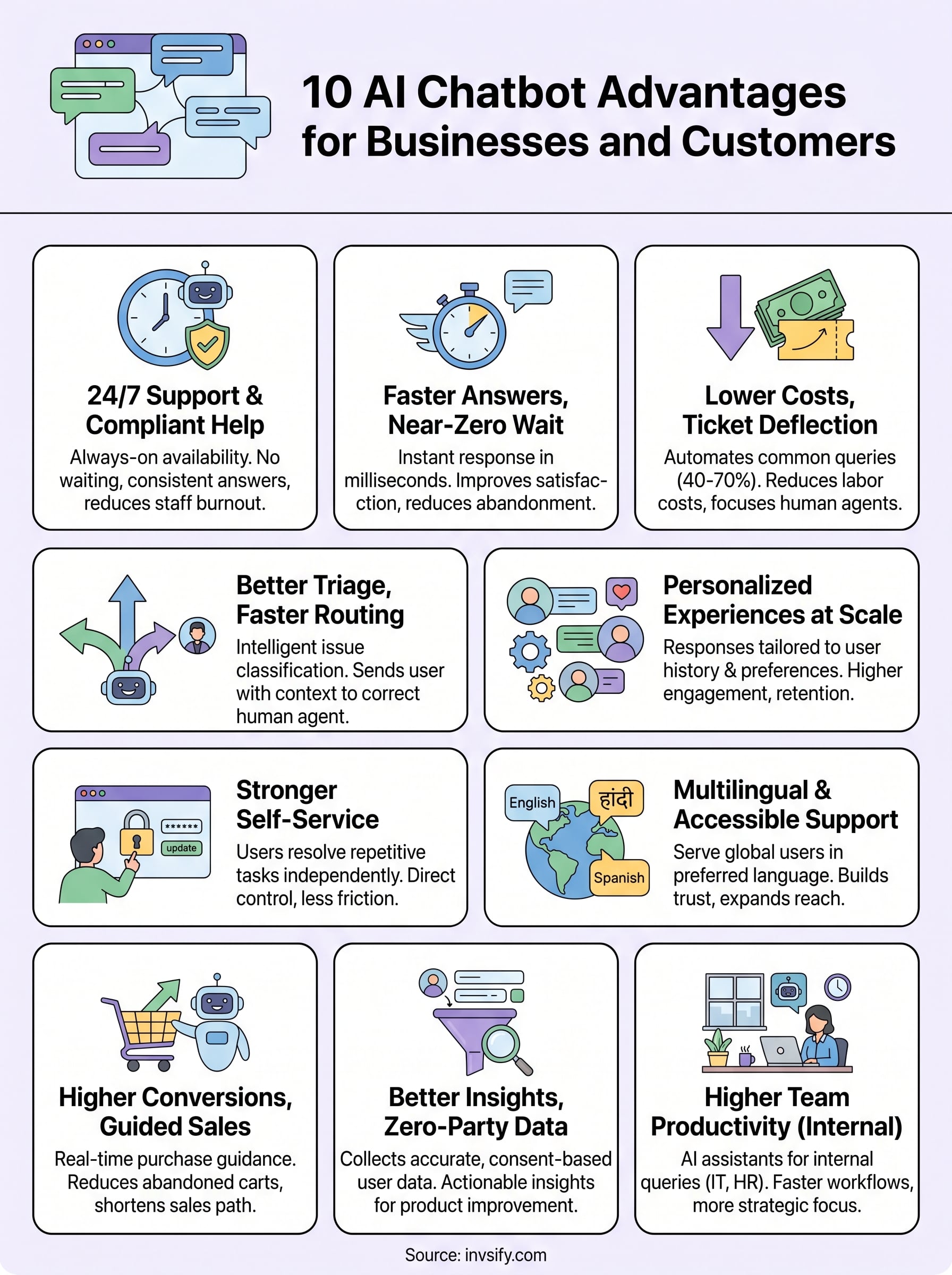
1. 24/7 support with compliant, always-on help
One of the clearest ai chatbot advantages is availability. Traditional support teams work fixed hours, which means customers in different time zones or with after-hours questions hit a dead end. A well-configured AI chatbot removes that barrier entirely, handling queries around the clock without adding headcount or burning out your staff.

What it improves for customers and businesses
For customers, always-on support means no waiting until Monday morning to resolve a routine query. For businesses, it means your support capacity doesn't drop at 6 PM. You reduce missed opportunities, frustrated users, and the pressure on your human agents to absorb volume spikes alone. That combination improves both retention and operational efficiency at the same time.
The shift from reactive to always-available support is where businesses see the biggest immediate gains in customer satisfaction.
Where it shows up in real workflows
This advantage is most visible in financial services, e-commerce, and healthcare, where users frequently need answers outside standard hours. A user reviewing portfolio performance at 11 PM, a shopper tracking a Sunday delivery, or a patient checking prescription details all benefit from immediate access. Your chatbot handles routine queries instantly and queues complex ones for a human agent when business hours resume.
In regulated industries, this also means the chatbot can deliver compliant, pre-approved responses consistently, reducing the risk of off-script answers that create liability.
How to measure it
Track three core metrics to quantify the impact of your always-on chatbot:
After-hours resolution rate: percentage of queries fully resolved outside business hours
First contact resolution (FCR): how often the chatbot closes issues without any escalation
CSAT score: customer satisfaction ratings collected immediately after each chatbot session
These numbers give you a direct view of whether your chatbot is genuinely delivering value after hours or simply generating handoffs.
How to do it right
Your chatbot needs clear escalation rules so it resolves what it can and routes the rest without frustrating users. Keep your knowledge base updated on a consistent schedule so the bot doesn't serve outdated answers at 2 AM when no one is monitoring. Running monthly audits of after-hours conversations will surface gaps in coverage before they grow into complaints.
2. Faster answers that cut wait times to near zero
When customers have a question, they want an answer now, not after a 10-minute queue. One of the most practical ai chatbot advantages is response speed: a chatbot replies in milliseconds, regardless of how many users are active simultaneously. That instant response changes how customers feel about your brand before they even read the answer.
What it improves for customers and businesses
Customers get immediate resolution instead of sitting in a queue or refreshing an email inbox. Businesses gain a measurable lift in satisfaction scores and fewer abandoned support sessions. When wait time drops to near zero, the gap between asking a question and taking action shrinks, which directly lifts conversion rates and reduces drop-off during onboarding or checkout.
Cutting response time from minutes to seconds is one of the fastest ways to reduce customer churn in high-volume support environments.
Where it shows up in real workflows
Speed matters most in transactional moments: account verification, order status checks, and payment queries. In financial services, a user waiting to confirm whether a transaction processed loses confidence every second that passes. Your chatbot can surface that answer instantly from integrated data sources, removing friction at the exact point where users are most likely to disengage.
How to measure it
Track these three numbers to gauge chatbot speed performance:
Average first response time: how quickly the chatbot sends its first reply
Resolution time: total time from query to closed ticket
Abandonment rate: percentage of users who leave mid-session before getting an answer
How to do it right
Connect your chatbot to live backend systems so it pulls real-time data rather than cached answers. Test response accuracy on a regular schedule because speed without accuracy erodes trust faster than a slow response ever would.
3. Lower support costs through ticket deflection
Hiring more agents to handle growing query volume is expensive and slow to scale. One of the most quantifiable ai chatbot advantages is ticket deflection: the chatbot resolves common queries completely, so those tickets never reach your human team. Businesses typically report deflection rates between 40% and 70%, which translates directly into reduced labor costs and faster resolution for customers.
What it improves for customers and businesses
Customers get faster answers on routine issues without waiting in a queue. Your team, meanwhile, focuses on complex, high-value cases that actually require human judgment. That shift improves agent morale and reduces burnout, since staff aren't spending hours answering the same five questions repeatedly.
Deflecting repetitive tickets isn't about replacing your team; it's about directing their time toward work that creates real value.
Where it shows up in real workflows
Ticket deflection works best on high-frequency, low-complexity queries like account balance checks, FAQ responses, subscription status updates, and basic troubleshooting steps. In financial services, these include fund NAV lookups, SIP status queries, and tax document requests. Each deflected ticket removes cost from your operation without degrading the customer experience.
How to measure it
Track your deflection rate (resolved chatbot sessions divided by total inbound volume) alongside cost-per-ticket before and after chatbot deployment. These two numbers give you a clear picture of your return on investment.
How to do it right
Build your chatbot around your top 20 query types first. Expand coverage gradually as you confirm accuracy, rather than trying to automate everything at launch.
4. Better triage and routing to the right human faster
Not every customer issue belongs in the same queue. One of the more underrated ai chatbot advantages is intelligent triage: the chatbot gathers context upfront, classifies the issue, and sends the user to the right agent or department before a human even picks up the conversation. That eliminates the frustrating experience of being transferred three times before reaching someone who can actually help.
What it improves for customers and businesses
Customers spend less time re-explaining their problem because the chatbot already collected and passed along the relevant context. For businesses, smarter routing means agents receive pre-qualified conversations with enough detail to start solving immediately. That reduces handle time, improves first-contact resolution, and makes better use of your specialist staff.
Routing the right query to the right person, with context already attached, is where chatbots create the most immediate efficiency gains for support teams.
Where it shows up in real workflows
This shows up clearly in financial services and healthcare, where routing errors have real consequences. A user with a billing dispute should not land in the technical support queue. Your chatbot can ask two or three qualifying questions, identify the issue type, and direct the user to the correct team with a pre-filled summary ready to go.
How to measure it
Track transfer rate (how often a chatbot session still requires a human handoff) and misdirected ticket rate (cases routed to the wrong team after chatbot intake). Lower numbers on both indicate your triage logic is working.
How to do it right
Map your most common escalation paths before configuring routing logic. Build intake questions that capture issue type, account status, and urgency so agents receive genuinely useful context, not just a name and a vague complaint.
5. More personalized experiences at scale
Generic responses frustrate users who expect the product or service to know their context. One of the most compelling ai chatbot advantages is the ability to deliver personalized interactions to thousands of users at the same time, something a human team simply cannot replicate at volume.

What it improves for customers and businesses
Customers receive responses tailored to their history, preferences, and current situation rather than boilerplate answers. For businesses, personalization at scale means higher engagement, more relevant product recommendations, and stronger retention without expanding headcount. Every relevant response the chatbot delivers builds user trust faster than a generic reply ever could.
Personalization at scale is not about adding a user's first name to a message; it's about surfacing the right information at the right moment based on real context.
Where it shows up in real workflows
This advantage is highly visible in financial services and e-commerce, where user context changes frequently. A chatbot connected to your CRM or portfolio data can show a user their specific holdings, recent transactions, or goal progress without them having to explain their situation from scratch each time.
How to measure it
Track engagement rate (percentage of users who complete a full chatbot session) and repeat usage rate over 30 and 60 days. Higher repeat usage signals that your chatbot is delivering genuinely relevant value rather than static responses.
How to do it right
Connect your chatbot to live user data and define clear personalization rules based on account type, history, and behavior. Avoid over-personalizing in ways that feel intrusive; relevance should feel helpful, not surveillance-like.
6. Stronger self-service for repetitive tasks
Users don't want to contact support for tasks they should be able to handle themselves. One of the most practical ai chatbot advantages is enabling genuine self-service for repetitive, low-complexity tasks, freeing both users and agents from unnecessary back-and-forth.
What it improves for customers and businesses
Customers gain direct control over routine actions like resetting passwords, updating contact details, checking order history, or downloading statements. Businesses reduce inbound volume on tasks that add no strategic value to their support team's workload. That means your agents spend less time on low-effort tickets and more time on issues that genuinely require human judgment.
When users can resolve simple tasks themselves in under a minute, they feel more confident in your product.
Where it shows up in real workflows
Self-service chatbots are most effective in financial platforms, SaaS products, and e-commerce, where users repeat the same account management actions frequently. Think SIP pause requests, invoice downloads, or address updates. Each of these tasks follows a predictable, structured flow that a well-built chatbot handles without human involvement.
How to measure it
Track your self-service completion rate (tasks fully resolved without agent involvement) and monitor the volume drop on your top five repetitive ticket categories month over month. A rising completion rate paired with declining agent tickets on those same categories confirms the chatbot is doing its job.
How to do it right
Map your highest-volume repetitive tasks first and build chatbot flows around those specific actions. Keep each flow short, confirm the action clearly, and give users an easy path to reach a human if something goes wrong.
7. Multilingual and accessible support for more users
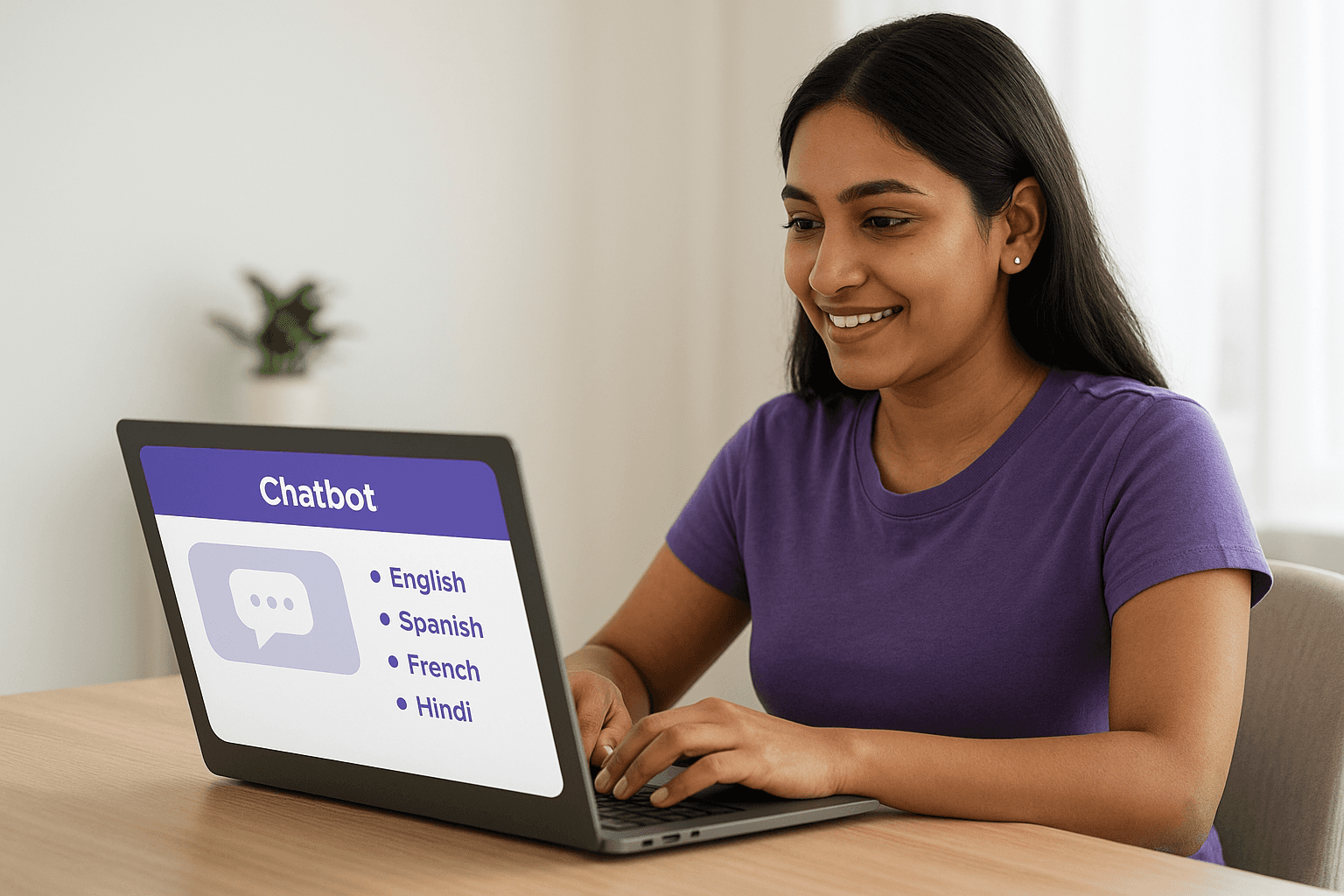
Language barriers and accessibility gaps push users away before they ever get help. One of the most practical ai chatbot advantages for global and diverse markets is the ability to serve users in their preferred language, without building separate teams for each region or dialect.
What it improves for customers and businesses
Users who interact in their native language make fewer errors, resolve issues faster, and report higher satisfaction. For businesses, multilingual support removes the need to hire specialized agents for every language market. You extend your reach to new customer segments without adding proportional cost to your support operation.
Removing language as a barrier dramatically expands the pool of users who can actually benefit from your product.
Where it shows up in real workflows
In financial services and healthcare, where terminology is complex and errors carry real consequences, native-language support builds trust faster than any translated PDF ever could. A user in Tamil Nadu asking about SIP returns or a user in Gujarat checking fund performance gets accurate, clear answers in their language, reducing miscommunication and drop-off.
How to measure it
Track language-specific CSAT scores and compare resolution rates across language sessions. A gap between English and regional language performance tells you exactly where your chatbot needs stronger training data or improved translations.
How to do it right
Train your chatbot on real conversational data in each target language, not just machine-translated text. Test responses with native speakers before deployment to catch phrasing that sounds technically correct but feels unnatural to actual users.
8. Higher conversions through guided shopping and sales help
Visitors who land on your product page with questions often leave without buying because no one is there to answer them in time. One of the most direct ai chatbot advantages is the ability to guide users through purchase decisions in real time, turning hesitant browsers into confirmed buyers without requiring a sales rep in the loop.
What it improves for customers and businesses
Customers get immediate answers about product fit, pricing, and availability at the exact moment they need them to make a decision. For your business, that means fewer abandoned carts and a shorter path from interest to conversion. A chatbot that asks the right qualifying questions and surfaces the most relevant product or plan acts like a knowledgeable sales assistant available at every hour.
Guiding a user to the right option at the right moment does more for conversion than any discount or pop-up ever will.
Where it shows up in real workflows
This works particularly well in financial services and subscription products, where users need clarity on plan differences, fees, or eligibility before they commit. A chatbot can walk a user through a simple comparison, confirm their requirements, and direct them to the right onboarding flow without friction.
How to measure it
Track chatbot-assisted conversion rate against sessions with no chatbot interaction. Also monitor drop-off points within guided flows to identify where users disengage.
How to do it right
Build your sales flows around real objections and common questions your team hears before a purchase. Keep the path short and confirm each step clearly so users feel confident, not pressured.
9. Better customer insights from zero-party data
Every chatbot conversation is a structured data point. One of the less obvious ai chatbot advantages is that your bot collects [zero-party data](https://invsify.com/blog/what-is-an-ai-chatbot), information users share directly and intentionally, rather than data you infer or scrape from behavior. That distinction matters because zero-party data is accurate, consent-based, and immediately actionable for improving your product and messaging.
What it improves for customers and businesses
Users benefit because the chatbot uses what they've shared to serve them better over time, not generic assumptions. Your business gains a clean, structured dataset on real user needs, pain points, and preferences that your analytics dashboards rarely capture on their own.
Zero-party data collected through chatbot conversations is often more reliable than survey responses because users share it in the context of trying to solve a real problem.
Where it shows up in real workflows
This shows up clearly in financial services and subscription products, where chatbot intake forms capture user goals, risk appetite, and product preferences during onboarding. That data feeds directly into personalization logic and product development decisions.
How to measure it
Track these two indicators to assess data quality:
Data completion rate: percentage of chatbot sessions where users answer qualifying questions fully
Insight utilization rate: how often captured data actively influences downstream recommendations or campaigns
How to do it right
Keep qualifying questions short and purposeful. Users will answer two or three focused questions during a natural conversation, but they will abandon a session that feels like a form disguised as a chat.
10. Higher team productivity with internal AI assistants
Most conversations about ai chatbot advantages focus on external customer interactions, but internal AI assistants deliver significant gains for your own team. Employees spend a surprising amount of time searching internal wikis, waiting on IT responses, or looking up HR policies. An internal AI assistant answers those questions in seconds, returning that time to productive work.
What it improves for customers and businesses
Your employees move faster on routine tasks when they have an AI assistant that knows your internal documentation, policies, and systems. For your business, that translates into lower overhead on internal support functions and a team that spends more hours on revenue-generating or strategic work rather than administrative friction.
Reducing the time your team spends searching for internal information compounds into significant productivity gains over a full quarter.
Where it shows up in real workflows
Internal chatbots show up in IT helpdesks, HR query handling, and compliance checks. An employee can confirm their leave balance, request software access, or check an expense policy without opening a ticket or waiting for a reply. In financial services, this includes regulatory compliance lookups and reporting support, which removes delays from time-sensitive workflows.
How to measure it
Track internal ticket volume before and after deployment alongside average resolution time for employee queries. A consistent drop in both confirms your internal assistant is reducing friction.
How to do it right
Index your most frequently accessed internal documents first and update them on a set schedule. Employees will only trust the assistant if its answers match the current version of your policies.
Next steps
The ten ai chatbot advantages covered in this article share a common thread: they solve specific, measurable problems that cost businesses time and money while frustrating customers. From 24/7 availability to smarter internal workflows, each benefit compounds when you build your chatbot around real user needs rather than feature checklists.
Your next move is to identify which two or three advantages apply most directly to your current gaps. Start there, measure the results, and expand your chatbot's scope once you have solid baseline data to build on. Trying to deploy everything at once typically produces a bloated bot that does nothing particularly well.
If you're managing your personal finances and want to see what a well-designed AI assistant looks like in practice, Invsify delivers AI-powered, conflict-free financial guidance backed by SEBI registration. Start building your wealth smarter today and experience how the right conversational AI changes your entire approach to investment decisions.