How Robo Advisors Work: Algorithms, Fees, And Portfolios
Shlok Sobti

How Robo Advisors Work: Algorithms, Fees, And Portfolios
Most investors in India have two choices: pay a traditional advisor who earns commissions on the products they sell you, or go it alone using tips from Reddit threads and YouTube videos. Neither option is great. That's exactly why understanding how robo advisors work has become essential for anyone serious about building wealth. These platforms use algorithms to do what human advisors do, assess your risk tolerance, build a portfolio, and rebalance it over time, but at a fraction of the cost and without the conflict of interest.
At their core, robo advisors collect information about your financial goals, time horizon, and comfort with risk. They then feed that data into algorithms that recommend a diversified portfolio, typically built from low-cost index funds or ETFs. The entire process, from onboarding to ongoing management, runs with minimal human intervention, which is what keeps fees low. But not all robo advisory platforms are created equal. Some rely purely on automation, while others, like Invsify's AI-powered advisory, blend algorithmic intelligence with SEBI-registered human expertise to give you the best of both worlds.
This article breaks down the mechanics behind robo advisors: the algorithms that drive investment decisions, the fee structures you should watch for, and how portfolios are actually constructed and managed. Whether you're evaluating your first robo advisor or comparing platforms, you'll walk away with a clear understanding of what's happening behind the screen, and what to look for before trusting one with your money.
What a robo advisor does and what it does not
A robo advisor is software that automates investment management using a rules-based algorithm. When you sign up, the platform asks you a series of questions about your income, financial goals, investment horizon, and risk tolerance. It takes your answers and maps them to a pre-built portfolio strategy, usually one of several risk profiles ranging from conservative to aggressive. The whole process replaces the intake meeting you would have with a human advisor, but it happens in minutes instead of days.
What a robo advisor actually does
Once your profile is set, the algorithm selects a mix of assets, typically low-cost index funds, ETFs, or mutual funds, designed to match your risk level and expected return target. It then monitors your portfolio continuously. When market movements push your asset allocation away from its target, the platform automatically rebalances by selling over-weighted assets and buying under-weighted ones. This keeps your portfolio aligned with your original strategy without you having to lift a finger.
Automatic rebalancing is one of the most underrated features of robo advisory platforms because it enforces discipline exactly when human investors tend to panic-sell or over-concentrate in recent winners.
Some platforms also run tax-loss harvesting, a process where losing positions are sold to offset taxable gains elsewhere in your portfolio. Combined with low expense ratios, these features compound into meaningful savings over a long investment horizon. Understanding how robo advisors work at this level helps you see that the value is not just convenience but also systematic, emotion-free portfolio management.
What a robo advisor does not do
A robo advisor does not replace every function of a qualified financial advisor. It cannot give you personalized advice on complex financial situations like estate planning, business succession, or navigating major life transitions. Algorithms perform well when your inputs fit neatly into defined categories, but your actual financial life rarely does.
Most robo platforms also do not provide real-time human judgment during extreme market events. In a sudden crash, an algorithm follows its programmed rules, which may or may not align with what is right for your specific situation at that moment. You will not get a call from someone who knows your full financial picture and can walk through your options with you.
Finally, robo advisors are not a substitute for financial literacy. The platform can build and manage a portfolio, but you still need to understand what you own, why you own it, and when your goals have shifted enough to warrant changing your strategy. Treating a robo advisor as a set-and-forget black box is one of the most common mistakes new investors make, and it often leads to holding the wrong portfolio for years without realizing it.
Why robo advisors matter for Indian investors
India has a serious advice gap. There are fewer than 1,400 SEBI Registered Investment Advisors for a population of over 1.4 billion people. The overwhelming majority of mutual fund distribution happens through commission-based distributors, which means the person recommending a product earns more when you buy higher-commission funds. Knowing how robo advisors work matters because it shows you what conflict-free, algorithm-driven advice actually looks like compared to what most Indian investors receive today.
The cost problem with traditional advisors
Most salaried investors in India deal with mutual fund distributors rather than registered advisors. These distributors earn trail commissions ranging from 0.5% to 1.5% of your invested amount every single year, whether or not your portfolio grows. On a portfolio of ₹20 lakhs, that means ₹10,000 to ₹30,000 quietly leaving your wealth annually before you even account for market returns. Over a 20-year investment horizon, that compounding drag can reduce your final corpus by several lakhs.
Switching from a commission-based distributor to a fee-only or algorithm-driven advisory model can add significant wealth to your final corpus simply by removing annual commission drag.
The access problem for middle-income investors
Traditional human wealth managers in India typically set minimum thresholds of ₹50 lakhs or more in investable assets. If you are a salaried professional building wealth from a monthly SIP, you are simply not their target client. Robo advisors change that equation by making professional-grade portfolio management available at every investment level, with some platforms accepting investments as small as ₹500. You get structured asset allocation, automatic rebalancing, and data-driven recommendations without needing to cross an arbitrary wealth threshold to qualify. For the growing base of urban salaried Indians who earn well but are not yet HNIs, this is a genuine shift in who gets access to quality financial guidance.
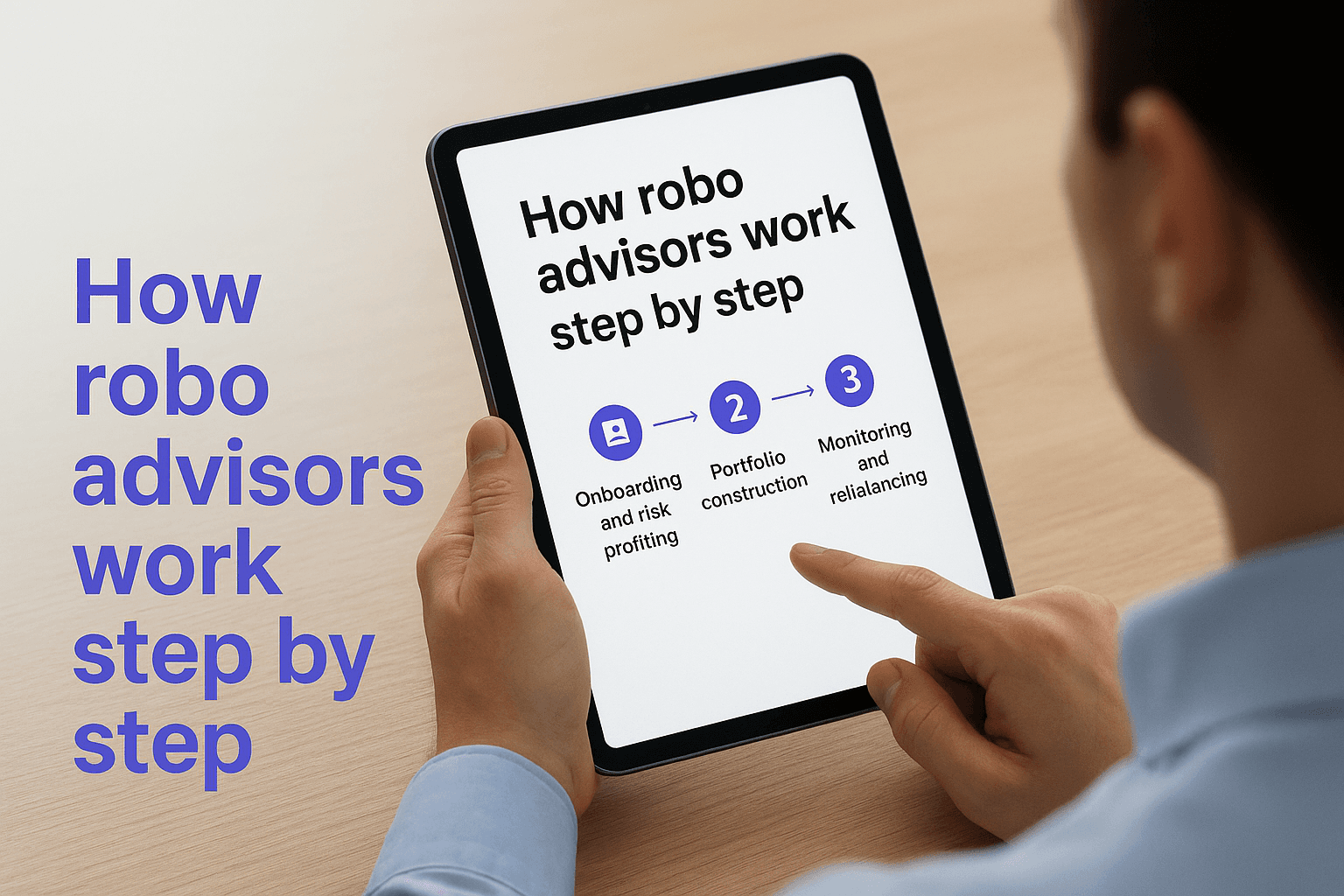
How robo advisors work step by step
Understanding how robo advisors work in sequence helps you see the full picture, from the moment you sign up to the point where your portfolio runs on autopilot. The process is more structured than most investors expect, and each stage feeds directly into the next.
Step 1: Onboarding and risk profiling
When you first create an account, the platform walks you through a structured questionnaire covering your age, income, financial goals, investment timeline, and comfort with market volatility. Your answers generate a risk score that the algorithm uses to match you to a portfolio strategy. This step takes anywhere from five to fifteen minutes, and the quality of your answers directly determines how well the recommended portfolio fits your actual needs.
Treat the onboarding questionnaire as seriously as you would a doctor's intake form. Inaccurate inputs produce a portfolio that may look optimized but is actually misaligned with your real financial situation.
Step 2: Portfolio construction
Once your risk profile is set, the algorithm selects a specific mix of asset classes such as equity mutual funds, debt funds, or gold ETFs, weighted to match your target return and risk level. The platform calculates the exact allocation percentages and presents the portfolio for your review before any money moves. You can typically accept the recommendation as-is or, on more advanced platforms, adjust individual allocations within defined limits.
Step 3: Monitoring and rebalancing
After you invest, the platform continuously tracks your portfolio's actual allocation against its target. When market movements push any asset class beyond a set threshold, typically 5% above or below target, the algorithm triggers a rebalance automatically. It sells a portion of the over-weighted asset and buys more of the under-weighted one, bringing your allocation back in line. This keeps your risk level consistent over time without requiring any action from you.
What drives returns and what you pay in fees
Understanding how robo advisors work at a return level means looking at two things: the asset allocation model the algorithm uses and the cost structure sitting underneath your portfolio. Both directly determine how much wealth you actually accumulate over time, and both are things you can evaluate before committing to any platform.
What actually drives your returns
The algorithm drives returns through asset allocation, not stock picking. Decades of research show that how you divide your money across equity, debt, and alternative assets explains the vast majority of long-term portfolio performance. A robo advisor sets that allocation at onboarding and maintains it through automatic rebalancing, which means your returns track the performance of the underlying asset classes rather than depending on any individual fund manager's calls. The quality of the underlying index funds or mutual funds selected also matters, since lower expense ratios within each asset class translate directly into higher net returns for you.
Consistent rebalancing forces you to buy low and sell high systematically, which is something most individual investors fail to do because emotion gets in the way.
What you pay and where the costs hide
Most robo advisory platforms charge an annual advisory fee expressed as a percentage of assets under management, typically ranging from 0.25% to 1% per year. On top of that, the underlying funds themselves carry expense ratios that reduce your net returns further. When you add both layers together, your total annual cost becomes the most important number to compare across platforms.
Some platforms appear cheaper upfront but embed hidden distribution commissions inside the regular mutual fund variants they recommend rather than using direct plans. Direct mutual fund plans in India carry significantly lower expense ratios than regular plans, and a platform that routes you into regular plans quietly collects a trailer commission at your expense. Always confirm whether your platform uses direct or regular fund plans before you invest.
How to choose a robo advisor in India
Choosing the right platform comes down to three factors: regulatory standing, total cost structure, and how well the platform's capabilities match your actual financial situation. Most investors focus only on the interface or the brand name, which misses the variables that drive long-term outcomes. Understanding how robo advisors work behind the scenes gives you a real basis for comparison rather than surface-level impressions.
Check regulatory status first
Any platform managing your investments in India should hold a SEBI Registered Investment Advisor (RIA) registration. This designation means the platform is legally required to act in your interest, not earn commissions on the products it recommends to you. A platform operating without this registration may still offer useful tools, but it lacks the fiduciary obligation that protects you when its advice conflicts with a financial incentive. Verify the registration directly on the SEBI website before you transfer any money to any platform.
Compare fees across the full cost stack
Do not stop at the headline advisory fee. Add the expense ratios of the underlying funds the platform selects, and confirm whether those funds are direct or regular plan mutual funds. Regular plans carry trailing commissions that quietly reduce your returns every year. A platform charging 0.5% on direct plan funds will almost always cost you less overall than one charging 0.25% while routing you into regular plans with embedded commissions.
The cheapest-looking platform is not always the cheapest platform once you account for the full cost stack sitting underneath.
Match the platform to your financial complexity
If your financial situation involves tax planning, multiple income sources, or significant asset complexity, look for a platform that blends algorithmic recommendations with access to certified advisors. Pure automation handles straightforward goals well, but complex situations require human judgment at critical decision points, such as a job change, an inheritance, or a sudden market dislocation.

Next steps
You now have a clear picture of how robo advisors work: from the onboarding questionnaire that shapes your risk profile, to the algorithm that builds and rebalances your portfolio, to the full cost stack that quietly determines your actual net returns. The most important action you can take right now is to stop paying hidden trail commissions to distributors who carry no legal obligation to act in your interest.
Choosing the right platform means verifying SEBI-registered advisory credentials, confirming the platform routes you into direct plan mutual funds, and checking whether human support is available when your financial situation gets complex. Pure automation handles straightforward goals well, but blending AI-driven recommendations with certified human oversight gives you a meaningful edge at critical decision points. If you want that combination backed by transparent, conflict-free pricing, get started with Invsify today and take control of where your wealth is actually headed.