How To Track Investments In One Place: Tools & Steps
Shlok Sobti

How To Track Investments In One Place: Tools & Steps
You've got mutual funds with one AMC, stocks in a demat account, a couple of fixed deposits with your bank, and maybe some NPS contributions running on autopilot. Each one has its own app, its own login, its own way of showing returns. Figuring out how to track investments scattered across five different platforms isn't just annoying, it's a real obstacle to making smart financial decisions.
When you can't see your full portfolio in one view, you miss the big picture. You might be over-exposed to a single sector, sitting on underperforming funds, or paying fees you didn't even know existed. Tracking everything in one place isn't a luxury, it's the baseline for anyone serious about growing and protecting their wealth.
That's exactly the problem we built Invsify to solve. As a SEBI Registered Investment Advisor, Invsify combines advanced portfolio tracking with AI-powered insights so you can monitor all your investments from a single dashboard, and actually act on what the data tells you.
This guide walks you through the tools, platforms, and step-by-step methods to consolidate your investments into one place, understand your real returns, and take control of your financial progress.
What you need before you start tracking
Before you figure out how to track investments effectively, you need to gather the right inputs. Going into a tracking tool with incomplete data means you'll get an incomplete picture, and that can be just as misleading as having no picture at all. Two things matter most here: knowing exactly where your money is, and having the documents that confirm it.
Incomplete data going into your tracker means incomplete decisions coming out of it.
Your PAN and linked financial accounts
Your PAN (Permanent Account Number) is the single most important identifier in the Indian financial system. Almost every investment you've made, from mutual funds to stocks to NPS, is linked to it. Before you start tracking, confirm that your PAN is linked to your demat account, your AMC folios, your NPS PRAN, and your bank accounts. If any of these connections are missing, you'll have blind spots in your consolidated view that no tracking tool can fill.
Documents you need to gather
Pull these together before you open any tracking platform:
Document | Where to get it |
|---|---|
CAS (Consolidated Account Statement) | Request from CAMS or KFintech online portals |
Demat holdings statement | Download from your broker's app or website |
Bank FD details | Collect principal, rate, and maturity date from your bank |
NPS statement | Log into the NPS portal and download the latest statement |
PPF and EPF passbook | Note current balance and interest credited |
Having these documents ready before you set up any tracker cuts setup time in half and ensures your numbers are accurate from day one, not patched together later.
Step 1. List every account and asset you own
Before you learn how to track investments effectively, you need a complete inventory. Most people underestimate how many accounts they actually hold, and missing even one fixed deposit or forgotten mutual fund folio can distort your net worth calculation significantly.
A missing account doesn't mean a missing asset, but it does mean a missing opportunity to optimize.
Build your asset inventory
Open a simple spreadsheet and capture every account you own. For each asset, record the account type, institution name, approximate current value, and the login or reference number you'll need to import it later. Don't skip illiquid assets like PPF or EPF just because they're locked in.
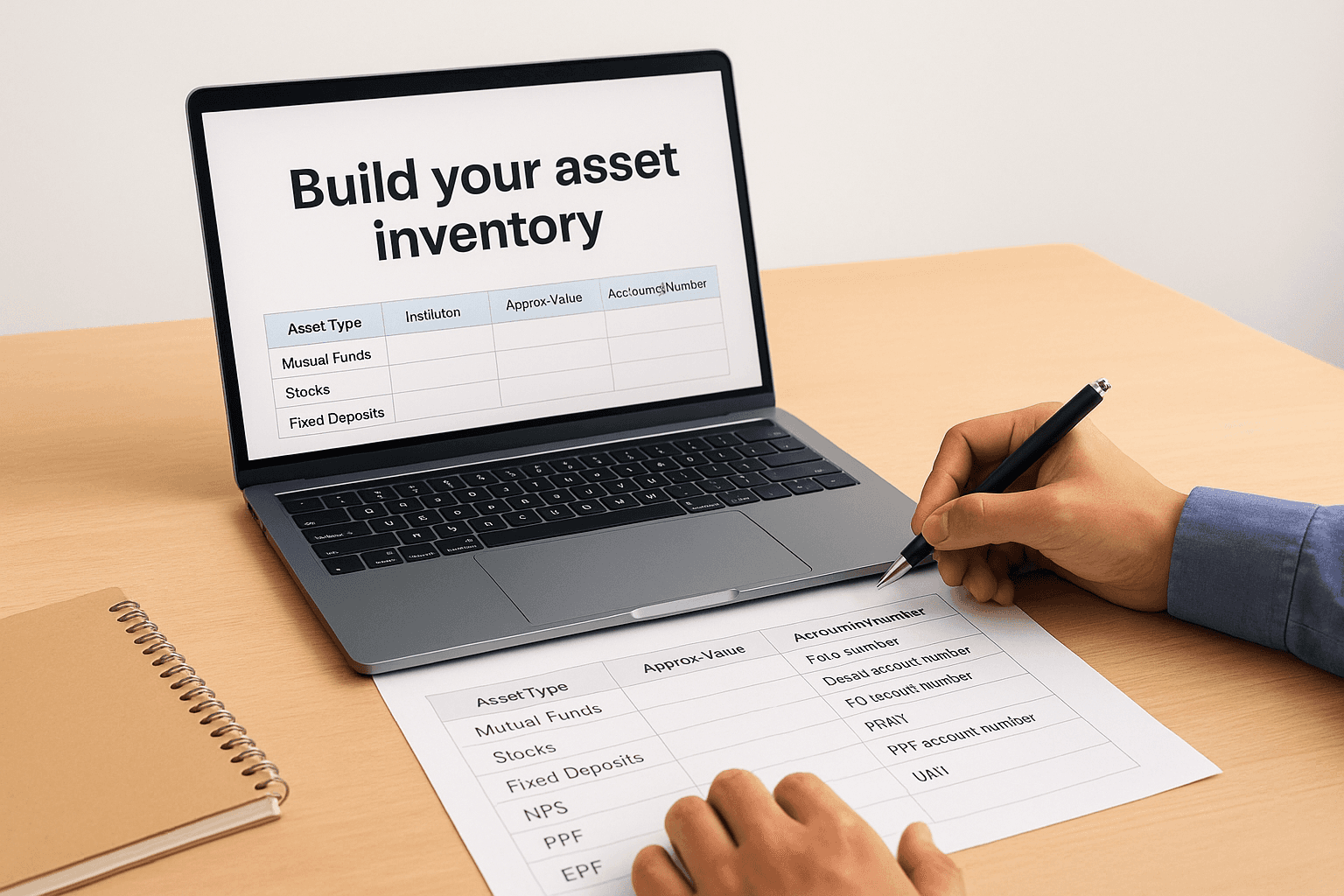
Use this template to get started:
Asset Type | Institution | Approx. Value (₹) | Account/Folio Number |
|---|---|---|---|
Mutual Funds | AMC / CAMS / KFintech | - | Folio number |
Stocks | Broker | - | Demat account number |
Fixed Deposits | Bank | - | FD receipt number |
NPS | NPS Trust | - | PRAN |
PPF | Bank / Post Office | - | PPF account number |
EPF | EPFO | - | UAN |
Fill in the approximate value column even if the number isn't exact. The goal is a complete list, not a perfect one. You'll refine the numbers in the next step when you import actual data.
Step 2. Pick the right tracking method for India
Once you have your asset inventory ready, you need to decide how to track investments on a consistent basis. India has two realistic options, and the right one depends on how many asset types you hold and how much time you want to spend on upkeep each month.
The best tracking method is the one you will actually use consistently every month.
Manual spreadsheet tracking
A spreadsheet works well if you hold fewer than five accounts and don't mind updating values yourself. Use Google Sheets and create columns for asset type, current value, purchase cost, and absolute and XIRR returns. The main drawback is that you have to pull numbers manually from each platform every time you review your portfolio, which creates room for error and delays.
Dedicated portfolio tracking platforms
India has SEBI-registered platforms that pull your mutual fund data directly via CAS and link to your demat for stock holdings. These give you a consolidated view with automated return calculations and asset allocation breakdowns without manual entry. For investors who want tracking combined with actionable advice, Invsify goes a step further by pairing portfolio monitoring with AI-powered personalized recommendations in one place.
Step 3. Import data with PAN, CAS, and statements
With your asset list ready and your tracking method chosen, the next step in how to track investments is actually pulling your data in. India's financial infrastructure makes this straightforward if you know where to look. Your PAN ties everything together, so every import you do will use it as the primary identifier.
Request your CAS from CAMS or KFintech
Your Consolidated Account Statement (CAS) covers all mutual fund folios linked to your PAN across every AMC in India. To get it, visit the CAMS or KFintech portals, enter your PAN and registered email, and request a detailed CAS with transaction history. You'll receive it by email within minutes. Upload this file directly into your chosen tracking platform to auto-populate your mutual fund holdings, purchase NAVs, and XIRR returns.
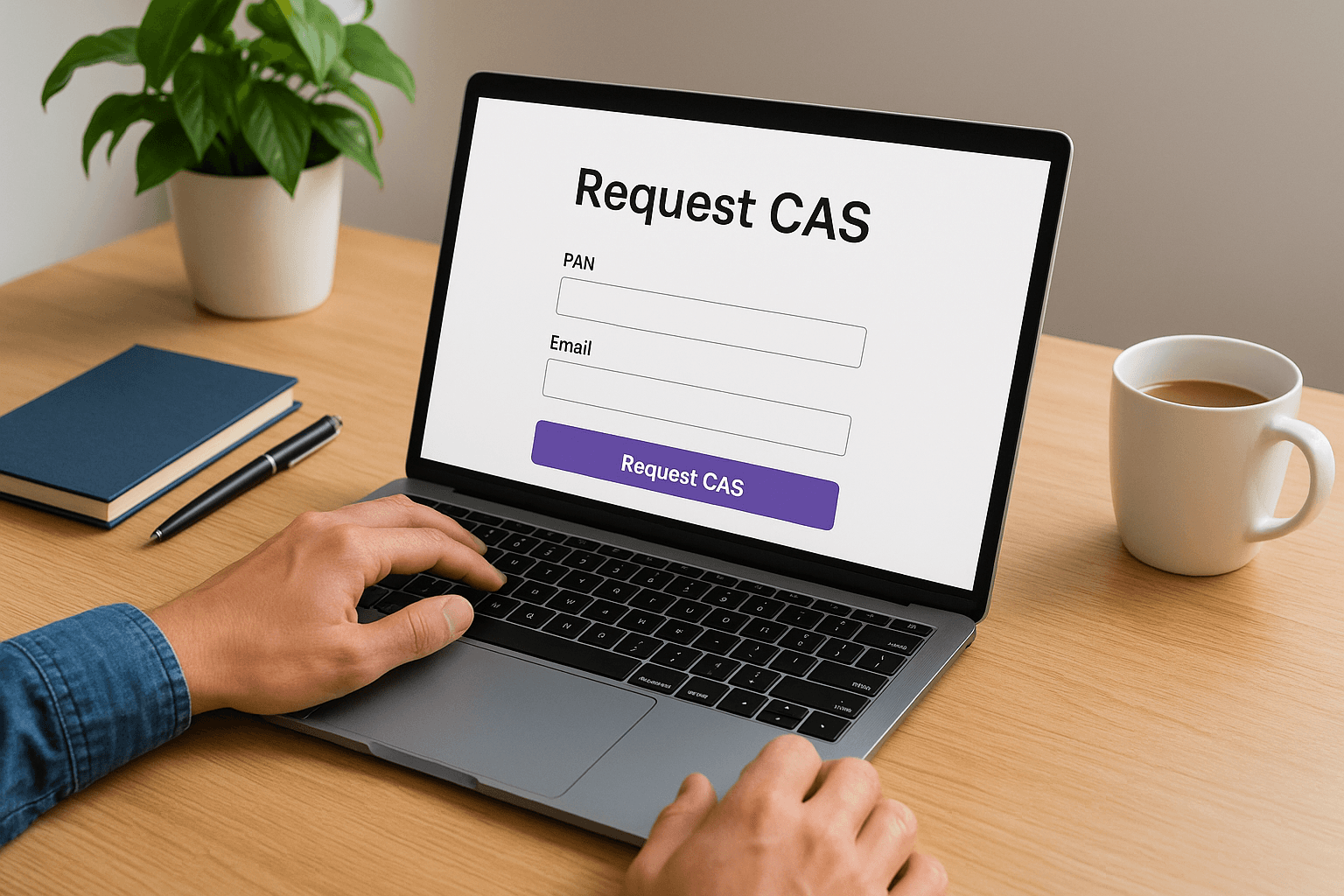
One CAS import can populate years of mutual fund transaction history in seconds.
Connect your demat and other accounts
For stocks, download your holdings statement from your broker's app in CSV or PDF format and import it into your tracker. For fixed deposits, NPS, PPF, and EPF, enter the values manually using the statements you collected in the preparation step. Update these once a quarter since they don't change daily.
Step 4. Monitor performance without overtracking
The final step in learning how to track investments well is knowing when to look at your portfolio and when to leave it alone. Checking your portfolio daily is one of the most common mistakes investors make. It creates anxiety, leads to reactive decisions, and pulls you away from your actual investment strategy without adding any useful information.
Frequent checking doesn't improve returns; it just gives you more chances to make emotional decisions.
Set a review cadence
Your portfolio needs a fixed review schedule, not open-ended access every time the market moves. A practical cadence for most investors is a monthly performance check and a deeper quarterly review for rebalancing decisions. Set a recurring calendar reminder so the review happens on your terms, not the market's.
What to measure at each review
Focus on XIRR (Extended Internal Rate of Return) rather than point-to-point returns, since XIRR accounts for the timing of every SIP installment and lump-sum contribution. Also track your asset allocation drift, meaning how far your equity-debt split has moved from your original target.
At each monthly review, run through this short checklist:
XIRR vs. target: Is your overall portfolio return meeting your financial goal?
Asset allocation drift: Has your equity-debt split shifted more than 5 to 10 percent?
Underperforming funds: Has any fund lagged its benchmark for three or more consecutive quarters?
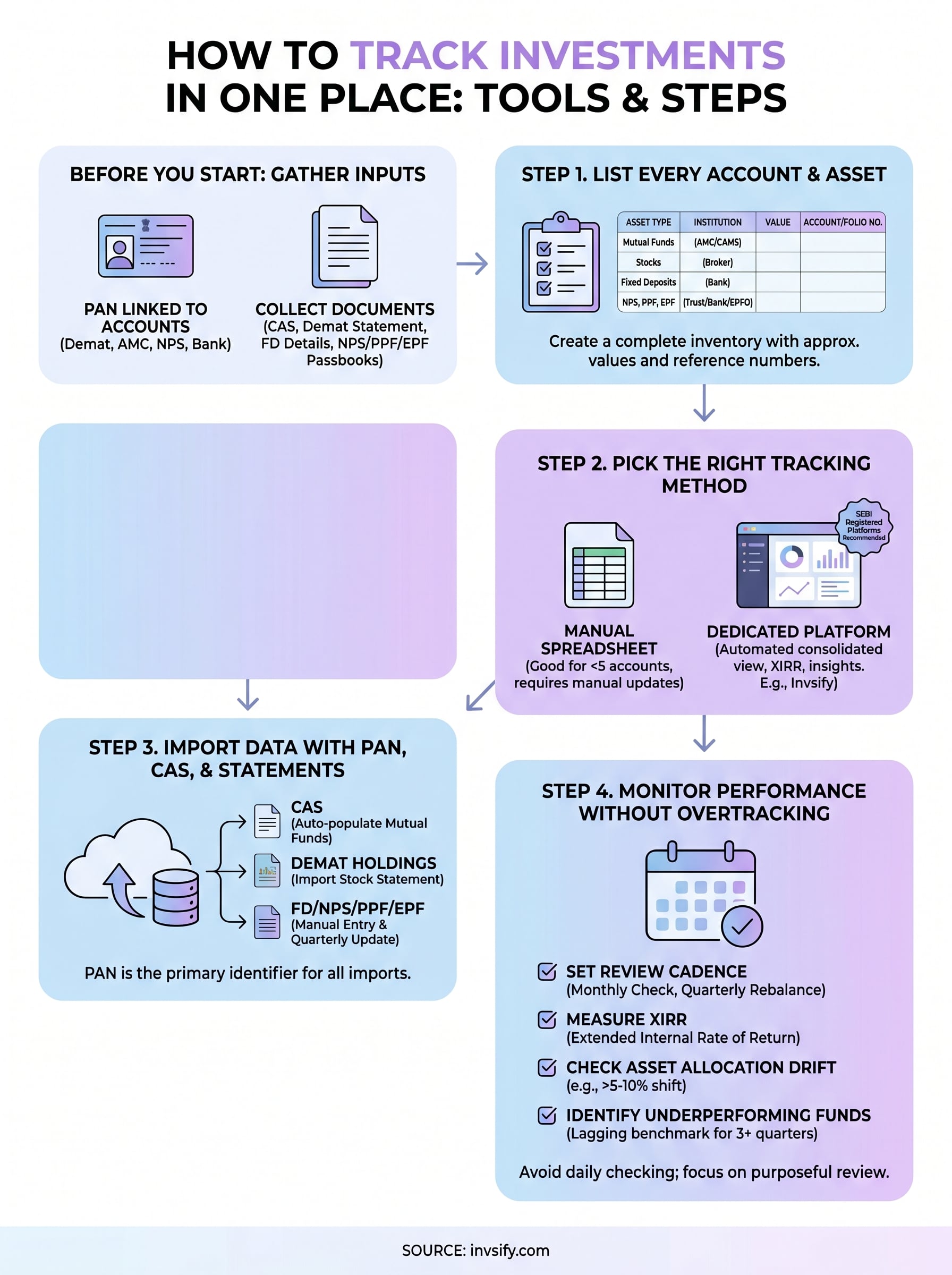
Your tracking routine from here
You now have everything you need to know how to track investments in one place. The process comes down to four repeatable steps: build a complete asset inventory, choose a tracking method that fits your portfolio size, import your data using CAS and account statements, and review on a fixed schedule rather than reacting to market noise. None of these steps require financial expertise, just consistency.
The investors who actually grow their wealth aren't the ones checking prices every day. They're the ones who review with purpose, act on data, and avoid emotional decisions triggered by short-term market swings. A clean, consolidated view of your portfolio is what makes that possible.
If you want a platform that combines portfolio tracking with AI-powered, conflict-free investment advice in a single place, start your free wealth review on Invsify and see exactly where your money stands today.