Morningstar Risk Profiler: Questionnaire, Scoring & Uses
Shlok Sobti
Morningstar Risk Profiler: Questionnaire, Scoring & Uses
Every sound investment plan starts with one question: how much risk can you actually handle? The Morningstar Risk Profiler is one of the most widely used tools to answer that question, used by financial advisors and platforms globally to assess a client's risk tolerance through a structured questionnaire and scoring system. If you've ever been asked to fill out a risk assessment before investing, there's a good chance Morningstar's methodology was behind it.
At Invsify, our AI-powered advisory platform uses risk profiling as a foundational step before recommending any investment. Understanding how tools like Morningstar's work gives you clarity on why your advisor, human or AI, suggests certain funds over others. It also helps you evaluate whether your current portfolio actually matches your comfort with risk.
This article breaks down the Morningstar Risk Profiler, how the questionnaire works, how scores are calculated, and how advisors and platforms use it in practice. Whether you're a self-directed investor curious about the methodology or a professional exploring risk profiling tools, you'll walk away with a complete, practical understanding of what this tool does and where it fits in the advisory process.
What the Morningstar Risk Profiler is and is not
The Morningstar Risk Profiler is a structured assessment tool designed to measure an investor's risk tolerance, risk capacity, and investment time horizon. It combines a questionnaire with a scoring framework to help advisors place clients into defined risk categories, which then guide fund and portfolio recommendations. Morningstar built this as part of its suite of advisor tools, often integrated into third-party platforms that financial professionals use to build and monitor client portfolios. It is not a consumer-facing app you download; it is primarily a professional tool licensed to advisors and advisory platforms.
What it actually is
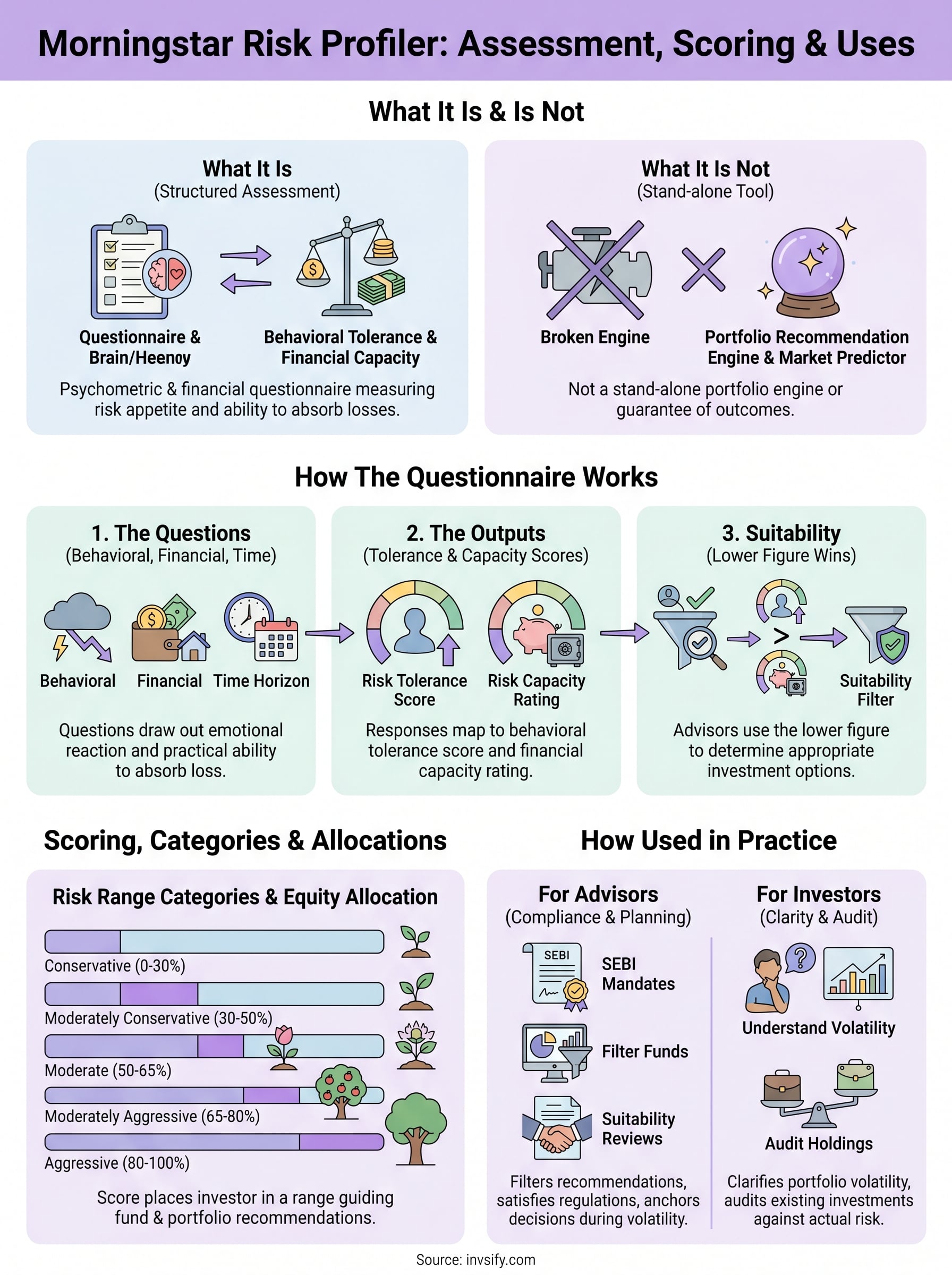
At its core, the Morningstar risk profiler is a psychometric and financial questionnaire that evaluates clients across two distinct dimensions: behavioral risk tolerance (how you feel about potential losses) and financial risk capacity (whether your income and obligations can absorb those losses). Both dimensions matter independently because someone with a high emotional tolerance for volatility may still lack the financial cushion to recover from a steep market decline without altering their goals or lifestyle. The scoring system then maps these responses to a risk category, which advisors use to filter appropriate investment options.
Risk profiling is not a one-time checkbox. It is a dynamic input that should be revisited whenever your financial situation, income, or goals change significantly.
What it is not
The profiler is not a stand-alone portfolio recommendation engine, and it does not predict market outcomes or guarantee that a recommended allocation will meet your needs over time. Many investors assume that completing a risk questionnaire means their investment plan is fully optimized. In reality, the questionnaire is only one input in a broader advisory process that must also account for tax efficiency, liquidity requirements, goal-specific timelines, and your overall financial picture.
Why risk profiling matters in India
In India, risk profiling is not optional. SEBI mandates that registered investment advisors assess a client's risk profile before making any investment recommendations, making it a legal and ethical baseline for advisory practice. Tools like the Morningstar Risk Profiler give advisors a structured, defensible way to meet that standard without relying on guesswork or informal conversations.
The regulatory baseline
SEBI's investment advisor regulations require advisors to conduct a suitability assessment that factors in your financial situation, investment objectives, and risk appetite. Without a formal risk profile on record, any recommendation is technically non-compliant. This is why most registered platforms in India build risk profiling directly into onboarding.
Skipping risk profiling does not protect you from market losses. It only removes the framework that could have prevented mismatched investments in the first place.
The behavioral reality
Indian retail investors often underestimate how they will react to a 20-30% portfolio drawdown during volatile markets. A structured questionnaire separates what you think you can handle from what your financial situation and behavioral patterns actually support. That gap is where poor investment decisions tend to happen, and risk profiling is the tool that closes it before damage is done.
How the questionnaire works
The Morningstar Risk Profiler questionnaire typically runs between 10 and 20 questions, depending on the advisor tool or platform using it. The questions draw out two types of information: your emotional reaction to financial loss and your practical ability to absorb it. Neither dimension alone gives the full picture, so both feed into a single composite assessment.
The types of questions asked
Questions fall into three structured categories, each carrying weighted values that accumulate into your final risk score:
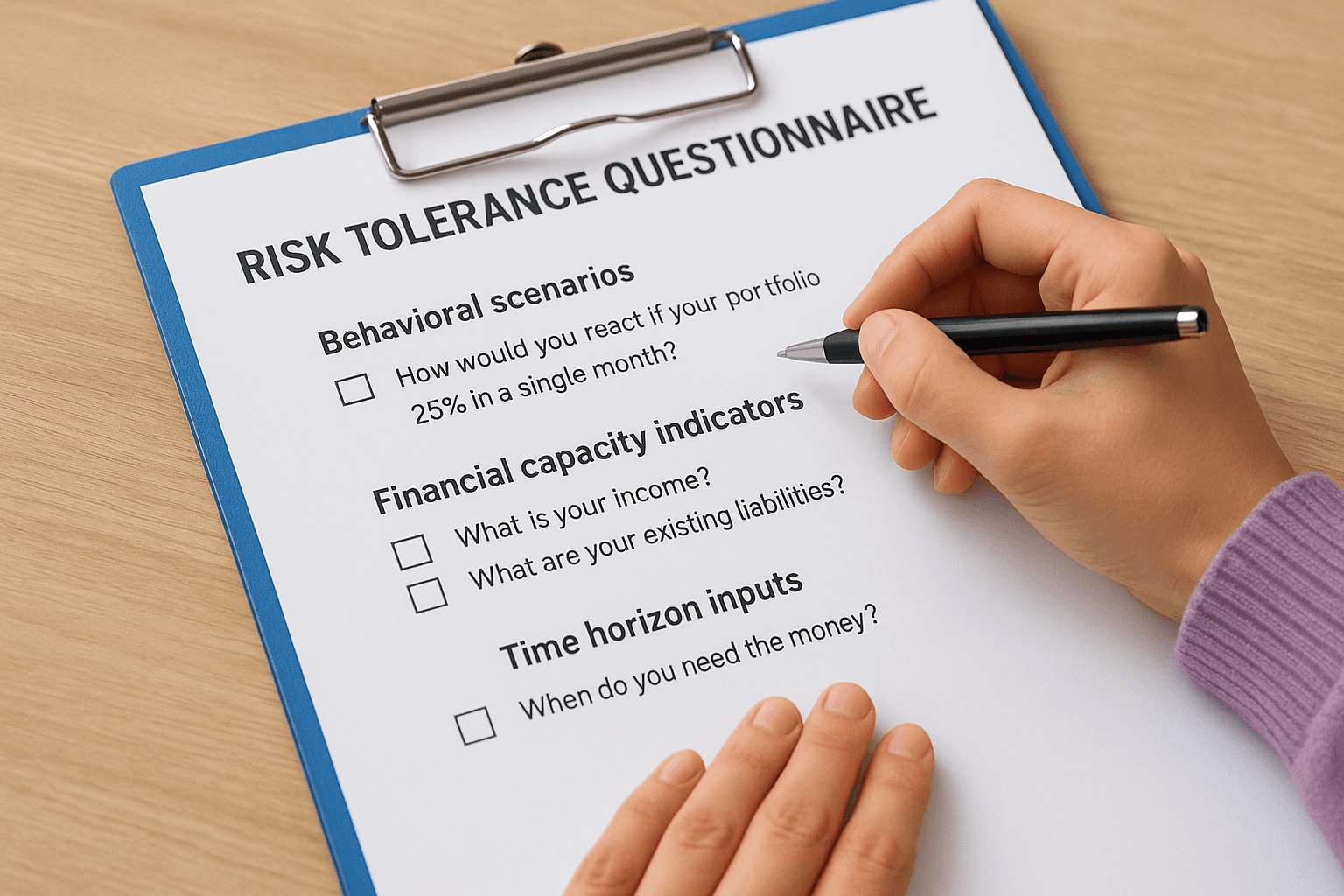
Behavioral scenarios: How you would react if your portfolio dropped 25% in a single month
Financial capacity indicators: Your income, existing liabilities, and emergency savings buffer
Time horizon inputs: When you need the money and how long you can realistically stay invested
What your answers reveal
Your responses map to two core outputs: your risk tolerance score and your risk capacity rating. When these two outputs diverge, your advisor uses the lower figure to determine appropriate investment suitability, because your financial safety net sets the practical ceiling for how much risk you can take regardless of how you feel about volatility. This prevents the common mistake of selecting aggressive portfolios that look good on paper but create real financial damage during downturns.
A mismatch between emotional tolerance and financial capacity is one of the most common reasons investors end up in portfolios that hurt them when markets fall.
How scoring, suitability, and ranges work
Once you complete the questionnaire, the Morningstar Risk Profiler converts your answers into a numerical score that places you within a defined risk range. Each range maps directly to an investment category, which then guides the type of funds and asset allocation your advisor recommends. The scoring accounts for both your behavioral tolerance and financial capacity, giving you a composite result rather than a single-dimension label.
The risk range categories
Your score lands in one of five standard ranges, each tied to a portfolio type and equity allocation percentage:

Risk Category | Typical Equity Allocation |
|---|---|
Conservative | 0-30% |
Moderately Conservative | 30-50% |
Moderate | 50-65% |
Moderately Aggressive | 65-80% |
Aggressive | 80-100% |
Your risk score is a starting point, not a permanent label. Revisit it whenever your income, goals, or financial obligations shift significantly.
How suitability is applied
Suitability is where the score becomes actionable advice. Your advisor uses your risk category to filter funds and products that align with your actual tolerance and financial capacity, ruling out options outside your range even when they are delivering strong short-term returns. This prevents emotionally driven decisions from disrupting a long-term financial plan. In India, where markets can be volatile and investor behavior is often reactive, suitability filtering through a structured tool like this is especially valuable.
How advisors and investors use the results
The output from the Morningstar Risk Profiler serves a different purpose for advisors than it does for investors. Advisors use it as a compliance and planning anchor, while investors use it as a reference point to understand why specific recommendations land in front of them.
How advisors apply the score
Advisors use your risk category to filter fund recommendations and build an asset allocation that stays within your defined range. The score also becomes part of your advisory file, satisfying SEBI's suitability documentation requirements. When markets shift sharply, advisors use your recorded risk profile to push back against emotionally driven requests to exit positions or over-concentrate in a single asset class. Advisors typically apply the score across three recurring workflows:
Initial portfolio construction and fund selection
Annual suitability reviews when your financial situation changes
Market volatility response calls to anchor client decisions
Your profile gives your advisor a documented basis for every recommendation, which protects both parties when investment outcomes are later questioned.
How you use the results
For investors, the score clarifies what kind of volatility your portfolio is built to absorb and helps you avoid second-guessing your allocation during normal market swings. Comparing your score against your current holdings reveals whether your existing investments were ever matched to your actual risk level, which is a useful audit for anyone transitioning from a traditional distributor to a regulated advisory service.
Where to go from here
The Morningstar Risk Profiler gives you a structured way to understand your relationship with risk before a single rupee moves into any investment. If you have never completed a formal risk assessment, or if your last one was done years ago under a traditional distributor, your current portfolio may not reflect your actual tolerance or financial capacity at all. That gap is worth closing before markets force the issue.
Your next step is straightforward. Start with a proper risk profile tied to your current income, goals, and time horizon, not the one you filled out during a rushed onboarding process. At Invsify, risk profiling is built into our AI-powered advisory process from day one, so every recommendation you receive connects directly to your actual financial situation. If you want advice that is conflict-free, SEBI-registered, and grounded in a real assessment of your risk profile, get started with Invsify today.