Portfolio Rebalancing Definition: Meaning, Steps, Strategies
Shlok Sobti

Portfolio Rebalancing Definition: Meaning, Steps, Strategies
You picked your mutual funds, set up your SIPs, and built a diversified portfolio. Six months later, one asset class has surged while another has lagged, and your original allocation looks nothing like what you planned. This is exactly where understanding the portfolio rebalancing definition becomes essential. Without periodic realignment, your portfolio quietly drifts toward a risk profile you never signed up for.
Portfolio rebalancing is the process of buying or selling assets to restore your portfolio to its target allocation. It sounds simple, but knowing when to rebalance, how to do it, and which strategy fits your situation makes a real difference in long-term outcomes. Whether you're a salaried professional managing ₹5 lakhs or ₹5 crores, the principle stays the same: your investments should reflect your goals, not whatever the market happened to do last quarter. Getting this wrong can mean taking on more risk during peaks and locking in losses during downturns.
This article breaks down what portfolio rebalancing means, the steps involved, and the strategies you can use to keep your portfolio on track. At Invsify, our AI-powered advisory platform monitors portfolio drift and delivers real-time, conflict-free recommendations, so rebalancing decisions are backed by data, not guesswork. Let's get into the fundamentals that every Indian investor should know.
What portfolio rebalancing means
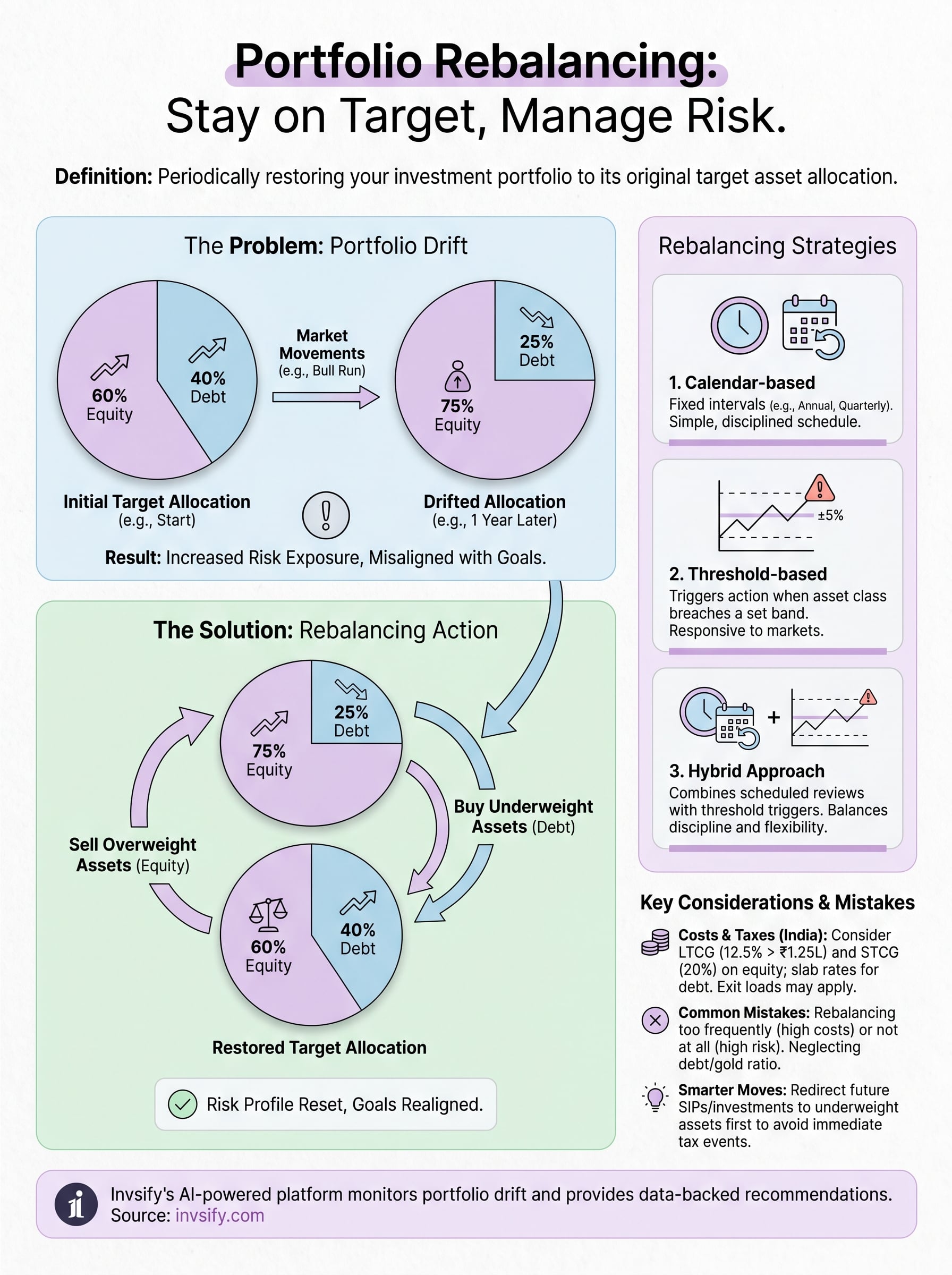
At its core, the portfolio rebalancing definition comes down to one idea: bringing your investments back to a predetermined target allocation after market movements have shifted the proportions. If you started with 60% equity and 40% debt, but a bull run in large-cap stocks has pushed your equity exposure to 75%, your portfolio now carries more risk than you originally planned. Rebalancing corrects that drift by selling some of the overweight assets and buying more of the underweight ones, restoring the balance you originally set.
The core mechanics of rebalancing
Every portfolio starts with an asset allocation that reflects your goals, time horizon, and risk tolerance. You might hold a mix of equity mutual funds, debt funds, gold ETFs, and fixed deposits. Over time, different assets grow at different rates, pulling your allocation away from its starting point. Rebalancing is the deliberate corrective action you take to reset those proportions back to their original targets.
Here is a straightforward example to make this concrete:
Asset Class | Target Allocation | Actual Allocation After 1 Year | Action Required |
|---|---|---|---|
Equity Mutual Funds | 60% | 72% | Sell excess |
Debt Funds | 30% | 22% | Buy more |
Gold ETFs | 10% | 6% | Buy more |
The table above shows how a portfolio drifts even when all assets are growing, because they grow at different speeds. Your job as an investor is to bring those percentages back in line before the drift compounds further.
How portfolio drift actually happens
Markets do not move in a straight line. When equity markets outperform, your equity allocation swells beyond your target, and your portfolio takes on significantly more risk than you intended. Conversely, when equity markets fall sharply, your debt proportion expands, leaving you underexposed to potential recoveries at exactly the wrong moment.

Portfolio drift is not a flaw in your original plan. It is a natural consequence of market movement, and the only way to counter it is through deliberate, periodic rebalancing.
For most Indian investors, drift becomes most visible during strong bull phases in the Nifty 50 or midcap indices. A portfolio that started balanced can end up carrying 80% or more in equity exposure after two or three years of strong returns. That dramatic shift changes the risk and volatility profile of your entire portfolio, often without you noticing until a correction hits hard.
Rebalancing versus reallocating
These two terms are easy to confuse, but they mean different things. Rebalancing means returning to your existing target allocation. Reallocating means deliberately changing the target itself, usually because your goals or timeline have shifted, for example, moving from an aggressive 80/20 equity-debt split to a moderate 60/40 split as you approach retirement.
Treating these as separate decisions keeps your strategy clear. Rebalancing is a regular maintenance activity, similar to servicing a vehicle on a fixed schedule. Reallocating is a strategic shift that should only happen when something fundamental about your financial situation or goals changes. Mixing the two up leads investors to either take on excessive risk during market highs or exit equity prematurely during downturns, both of which hurt long-term wealth building in ways that are difficult to recover from.
Why rebalancing matters for Indian investors
The portfolio rebalancing definition takes on added weight in the Indian context because of how dramatically domestic equity markets can swing in a short period. The Nifty 50 and midcap indices have historically delivered sharp rallies followed by steep corrections, meaning your equity allocation can drift significantly within a single financial year. For salaried investors running SIPs across multiple funds, that drift often goes unnoticed until the next market downturn makes the overexposure painfully obvious.
Ignoring portfolio drift in a volatile market does not keep your money safe. It silently reshapes your risk exposure in ways that can set back years of disciplined saving.
The equity concentration problem in India
Many Indian investors tend to concentrate heavily in equity mutual funds, especially during bull phases in large-cap and midcap segments. When these segments outperform for two or three consecutive years, your equity weighting can jump from 60% to 80% or beyond without any active decision on your part. At that point, a single market correction can wipe out returns that took years to accumulate. Rebalancing forces you to lock in some of those gains by moving a portion back into debt or gold, which cushions the impact when equity markets correct sharply.
Goal timelines make rebalancing non-negotiable
Your investment goals each carry a specific time horizon, and the closer you get to a goal, the less risk your portfolio should carry. A 35-year-old saving for retirement in 25 years can afford to ride out equity volatility. That same investor at 55, with a 5-year runway, cannot afford a 30% drawdown in the final stretch. Rebalancing aligns your portfolio's risk level with where you actually are on that timeline, not where you were when you first invested. Missing this adjustment is one of the most common and costly mistakes Indian investors make when approaching major financial milestones like retirement, a child's education, or a property purchase.
How SIP investors still need to rebalance
Running monthly SIPs does not automatically rebalance your portfolio. SIPs invest fixed amounts into pre-selected funds, but they do not adjust the proportions between asset classes as markets move. You still need to periodically review your overall allocation and make targeted purchases or redemptions to correct any drift that your SIP contributions alone cannot fix.
How to rebalance a portfolio step by step
Understanding the portfolio rebalancing definition is one thing; actually executing it is another. The process does not need to be complicated, but it does require a clear sequence to avoid making reactive decisions based on short-term market noise. Below is a practical, repeatable approach you can use regardless of whether your portfolio is ₹5 lakhs or ₹50 lakhs.
Check your current allocation against your targets
Before you make any moves, pull a consolidated view of your entire portfolio across all accounts, including equity mutual funds, debt funds, PPF contributions, gold ETFs, and any direct stocks you hold. Many investors spread investments across multiple platforms, which means drift can go completely unnoticed when you review each account in isolation. Once you have a full picture, calculate the current percentage of each asset class and compare it directly against your original target allocation.
Asset Class | Target % | Current % | Drift |
|---|---|---|---|
Equity Funds | 60% | 74% | +14% |
Debt Funds | 30% | 20% | -10% |
Gold ETFs | 10% | 6% | -4% |
Once you see the gap clearly laid out, you can make decisions based on actual numbers rather than assumptions or vague impressions about how your portfolio is doing.
The biggest rebalancing mistake is acting on gut feeling rather than a precise, calculated view of where your portfolio actually stands today.
Decide how to close the gap
You have three practical options once you identify the drift: sell the overweight asset and redeploy the proceeds into underweight categories, redirect upcoming SIP contributions toward the lagging asset classes, or deploy any lump-sum amounts into whatever is underweight. For most salaried investors running active SIPs, redirecting new contributions is the smartest first move because it avoids triggering capital gains taxes immediately and keeps your overall investment momentum intact.
Execute and document every change
After you decide your approach, place the actual transactions in one sitting rather than spreading them across days. Market conditions shift quickly, and delays create execution risk. Once the trades are done, record the date, the amounts moved, and your updated allocation in a simple spreadsheet. Keeping a rebalancing log like this helps you track how your portfolio drifts over time, making each future review faster and more informed. Set a calendar reminder for your next check so the process stays disciplined and scheduled rather than reactive and emotional.
Common rebalancing strategies and triggers
Knowing the portfolio rebalancing definition gives you the foundation, but choosing the right strategy determines how effectively you put that knowledge to work. There is no single approach that suits every investor, so understanding your main options helps you pick one that fits your schedule, portfolio size, and tax situation in India.
Calendar-based rebalancing
This strategy means you review and realign your portfolio at fixed time intervals, regardless of how much drift has occurred. Common schedules are quarterly, semi-annual, or annual reviews. Annual rebalancing works well for most salaried Indian investors because it aligns naturally with financial year-end planning and ELSS lock-in cycles. The main advantage is simplicity: you set a reminder, review your allocation, and make the necessary corrections on a predictable schedule without constantly monitoring market movements.
Rebalancing too frequently, such as monthly, often increases transaction costs and tax events without meaningfully improving long-term outcomes.
Threshold-based rebalancing
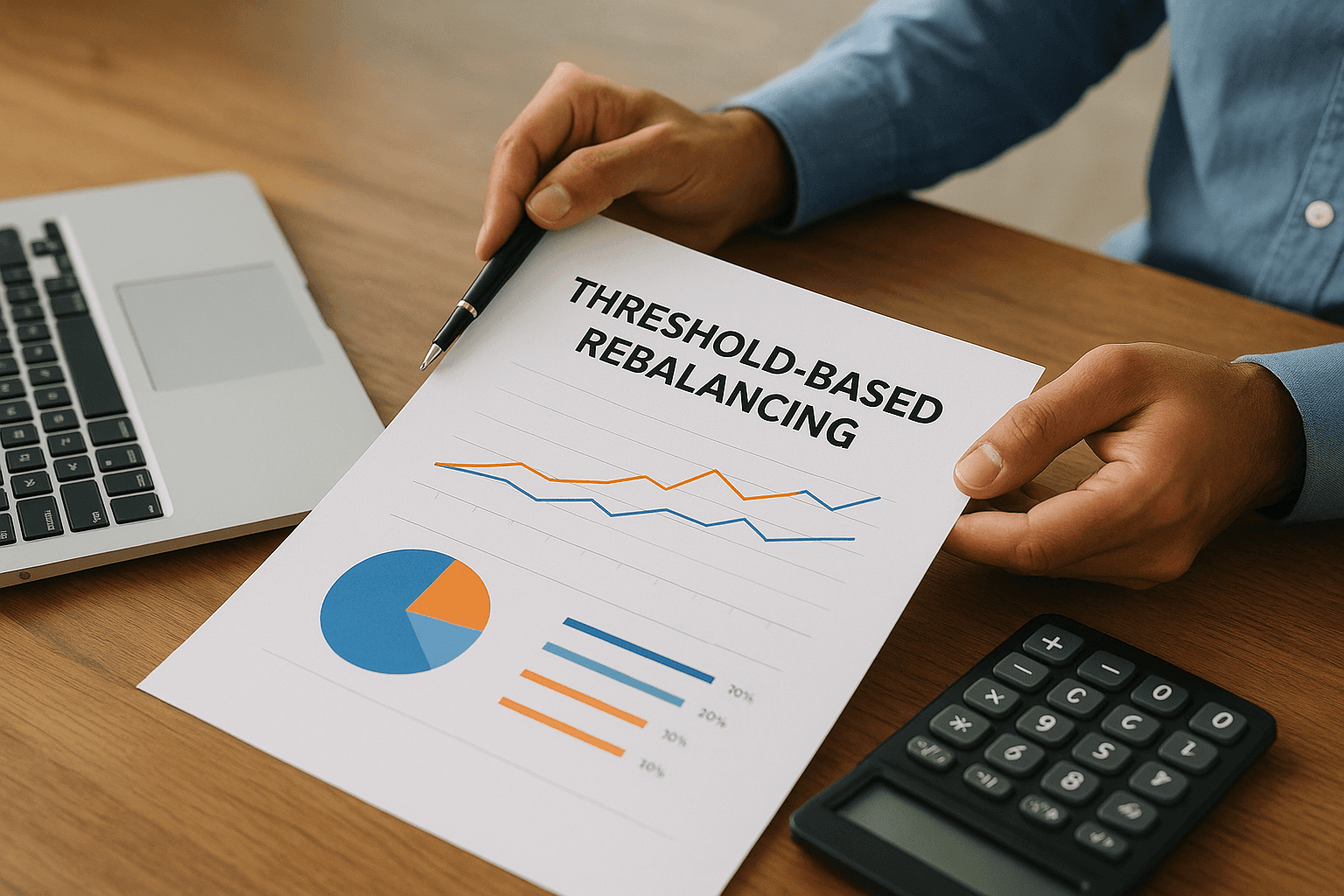
Instead of acting on a fixed date, threshold rebalancing triggers action only when an asset class drifts beyond a set band, typically 5% to 10% from your target allocation. For example, if your target equity exposure is 60%, you rebalance only when it crosses 65% or drops below 55%. This approach is more responsive to actual market conditions and avoids unnecessary transactions during periods of low volatility. The practical challenge is that it requires active, ongoing monitoring, which is where a platform like Invsify adds real value by tracking your portfolio continuously and flagging threshold breaches automatically.
Many experienced investors use a hybrid approach that combines both calendar and threshold triggers. You schedule a fixed annual review but also set a hard threshold, say a 10% drift, that prompts an earlier review if markets move sharply. This gives you the discipline of a schedule and the flexibility to respond when significant drift happens between your planned review dates. For Indian investors navigating fast-moving equity markets, this combination tends to reduce both the risk of excessive drift and the cost of over-trading, making it a practical middle ground that works across most portfolio sizes.
Costs, taxes, and mistakes to avoid in India
Applying the portfolio rebalancing definition in practice means dealing with real-world costs that can quietly erode the gains you're trying to protect. In India, rebalancing is not just a mechanical exercise because every redemption from a mutual fund or ETF can trigger a tax event, and exit loads on some funds add another layer of cost you need to factor in before placing any transaction.
Capital gains tax on redemptions
When you sell equity mutual fund units that you've held for more than one year, the gains fall under Long-Term Capital Gains, currently taxed at 12.5% beyond the ₹1.25 lakh annual exemption threshold under post-Budget 2024 rules. Units redeemed within one year attract Short-Term Capital Gains tax at 20%. For debt mutual funds, gains are added to your income and taxed at your applicable slab rate regardless of holding period. This tax structure means that rebalancing by redemption can cost you more than the benefit of realignment if your drift is small, which is why redirecting new SIP contributions toward underweight asset classes is often the smarter first move.
Checking your holding period and the unrealized gain on each fund before you redeem is not optional. It directly determines whether rebalancing through selling is cost-effective in your specific situation.
Common mistakes that hurt Indian investors
The most frequent mistake is rebalancing too often, typically after every minor market move, which racks up unnecessary tax events and exit loads without providing meaningful risk reduction. Conversely, many investors never rebalance at all, letting equity exposure run unchecked through extended bull markets and then suffering outsized losses when corrections arrive. Both extremes damage long-term wealth building in ways that compound over years.
Another common error is rebalancing only within your equity holdings, for example, shifting from midcap funds to large-cap funds, while leaving the broader equity-to-debt ratio completely untouched. This activity feels productive but does nothing to address the actual risk drift in your portfolio. Real rebalancing corrects the proportions across your entire asset mix, including equity, debt, and gold, not just within a single asset class. Keeping your rebalancing log current helps you avoid this mistake by showing the full picture every time you review.
A simple wrap-up
The portfolio rebalancing definition boils down to one disciplined habit: periodically reviewing your asset allocation and correcting any drift back to your original targets. Markets will always push your portfolio out of balance, and leaving that drift unchecked quietly increases your risk exposure in ways that only become obvious when a correction hits. Whether you choose a calendar-based schedule, a threshold trigger, or a hybrid of both, the key is consistency over perfection.
Tax efficiency, exit loads, and holding periods all shape how you execute each rebalancing decision in India, so reviewing your actual numbers before redeeming any fund is always worth the extra time. Redirecting SIP contributions toward underweight asset classes is often the simplest and most cost-effective first step. If you want an AI-powered platform that monitors your portfolio drift continuously and delivers conflict-free, data-backed recommendations, get started with Invsify and keep your investments aligned with your actual goals.