SEBI Registered Advisor: Meaning, Benefits, And Verification
Shlok Sobti

SEBI Registered Advisor: Meaning, Benefits, And Verification
Anyone can call themselves a financial advisor. There's no barrier to entry for giving investment opinions on YouTube, Twitter, or WhatsApp groups. But when real money is on the line, your savings, your retirement, your child's education, opinions aren't enough. What you need is a SEBI registered advisor, someone who is legally authorized and regulated by the Securities and Exchange Board of India to provide investment advice in your best interest, not theirs.
The distinction matters more than most people realize. A registered advisor operates under strict compliance guidelines, charges transparent fees, and is legally bound to act as a fiduciary. A distributor or unregistered "advisor," on the other hand, often earns commissions from the products they recommend, creating a conflict of interest that can quietly erode your wealth. At Invsify, we built our entire platform around this principle: as a SEBI Registered Investment Advisor, every recommendation we make through our AI-powered advisory is conflict-free and designed purely around your financial goals.
This article breaks down what a SEBI registered advisor actually is, how to verify their credentials through the official SEBI list, the concrete benefits of working with one, and the registration process for professionals looking to become one. Whether you're evaluating an advisor or considering the career path yourself, you'll walk away with the clarity you need to make an informed decision.
What a SEBI registered advisor is and is not
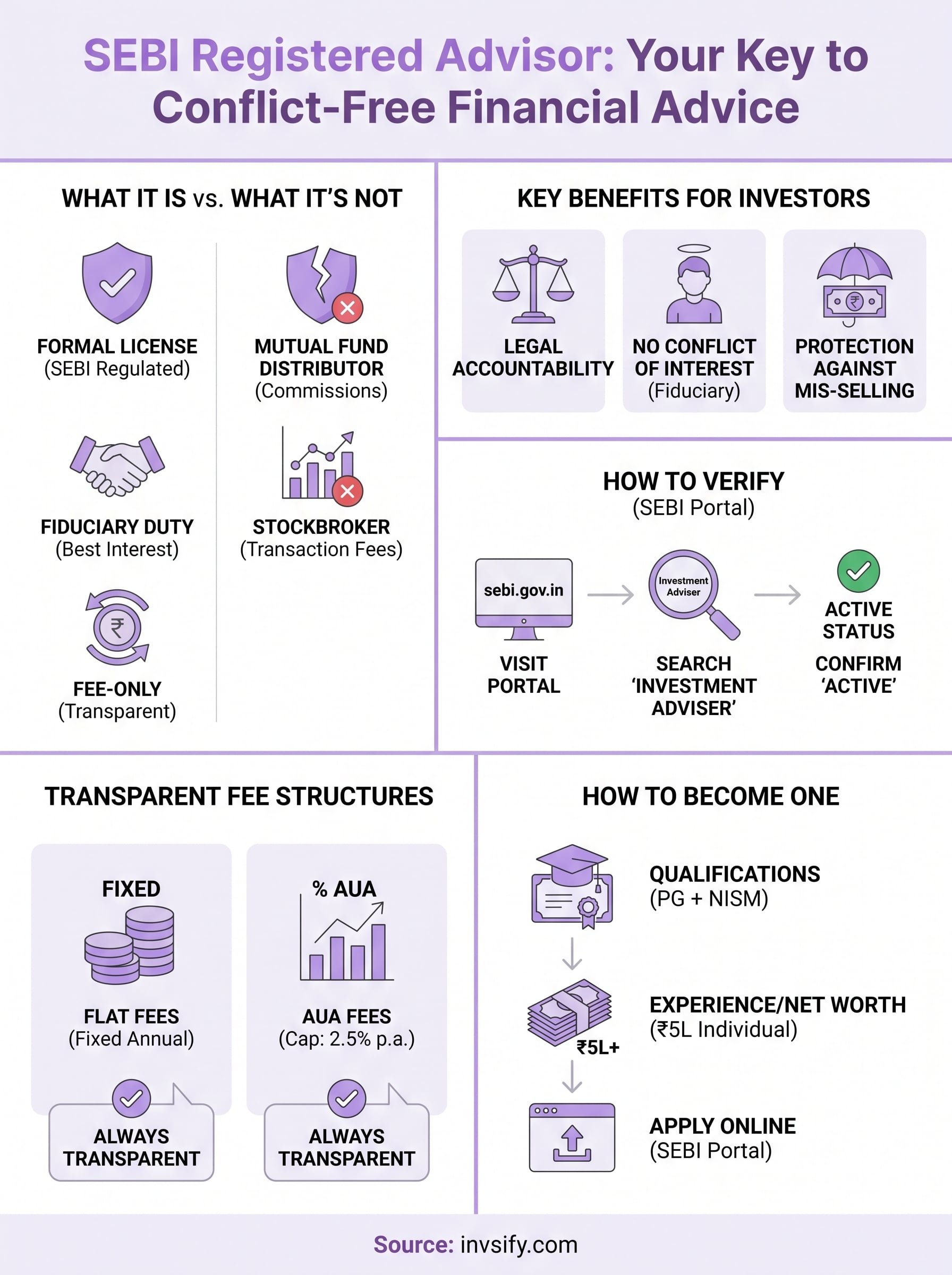
A SEBI registered advisor holds a formal license issued by the Securities and Exchange Board of India under the SEBI (Investment Advisers) Regulations, 2013. This registration means the advisor has met specific eligibility requirements, passed required examinations, and agreed to operate under a defined code of conduct. Think of it as the financial equivalent of a medical license: it signals not just expertise but accountability.
What defines a SEBI registered advisor
SEBI registration comes with three core obligations that separate these advisors from everyone else in the market. First, they must follow a fee-only compensation model, meaning they cannot earn commissions from the products they recommend. Second, they must conduct a risk-based Know Your Client (KYC) process and deliver advice suited to your individual financial profile. Third, they are required to maintain records and comply with periodic audits by SEBI.

This fee-only structure is the single most important difference between a registered advisor and a distributor who profits from your investment choices.
These rules exist to eliminate the conflict of interest that arises when an advisor earns more by recommending specific mutual funds or insurance products over others that may suit you better.
What a SEBI registered advisor is not
A SEBI registered advisor is not a mutual fund distributor. Distributors hold an AMFI Registration Number (ARN) and are permitted to sell mutual funds, but they earn a trail commission from the fund house on every rupee you invest. That commission creates a direct incentive to recommend products that pay them more, not products that serve you better.
Registered advisors are also not stockbrokers or sub-brokers. Brokers execute trades on your behalf and earn brokerage fees per transaction. Some brokers offer advisory services as an add-on, but unless they hold a separate SEBI investment adviser registration, that advice is not regulated under the Investment Advisers framework and carries none of the legal protections you receive from working with a properly licensed advisor.
Why SEBI registration matters for investors
Working with a SEBI registered advisor gives you something that no YouTube channel, Reddit thread, or commission-driven distributor can provide: legal accountability. SEBI registration is not a badge of honor; it is a binding contract between the advisor and the regulator that puts your financial interest at the center of every recommendation.
Legal accountability and fiduciary duty
A registered investment advisor is legally required to act in your best interest, a standard known as fiduciary duty. If an advisor steers you toward a product that benefits their pocket rather than your portfolio, they can face regulatory action, penalties, or even cancellation of their registration by SEBI. This creates a real deterrent that does not exist in unregulated advice channels. You have a formal grievance mechanism through SEBI's SCORES platform, so your complaints do not disappear into a void.
The fiduciary obligation is what separates regulated advice from recommendations shaped by commissions.
Protection against mis-selling
Mis-selling is one of the most common and financially damaging problems in India's retail investment space. Distributors frequently push high-commission ULIPs or underperforming funds simply because those products pay them more. A SEBI registered advisor earns a flat fee directly from you, removing the financial incentive to recommend anything other than what genuinely fits your goals, risk profile, and time horizon. That single structural difference protects your wealth in ways that most investors underestimate until they calculate the cost of years of mis-sold products.
How to verify a SEBI registered advisor
Before trusting anyone with your money, confirm their credentials. SEBI maintains a publicly accessible database of all registered investment advisers on its official intermediary portal at sebi.gov.in. The process takes under two minutes and confirms whether an advisor is legally authorized to give you financial advice.
Steps to check on the SEBI intermediary portal
Visit the SEBI intermediary portal and select "Investment Adviser" from the intermediary type dropdown. You can search by registration number, name, or city. If the advisor appears with an active status, their registration is valid. If they do not appear, they hold no authorization under the Investment Advisers Regulations, regardless of what their business card or website claims.
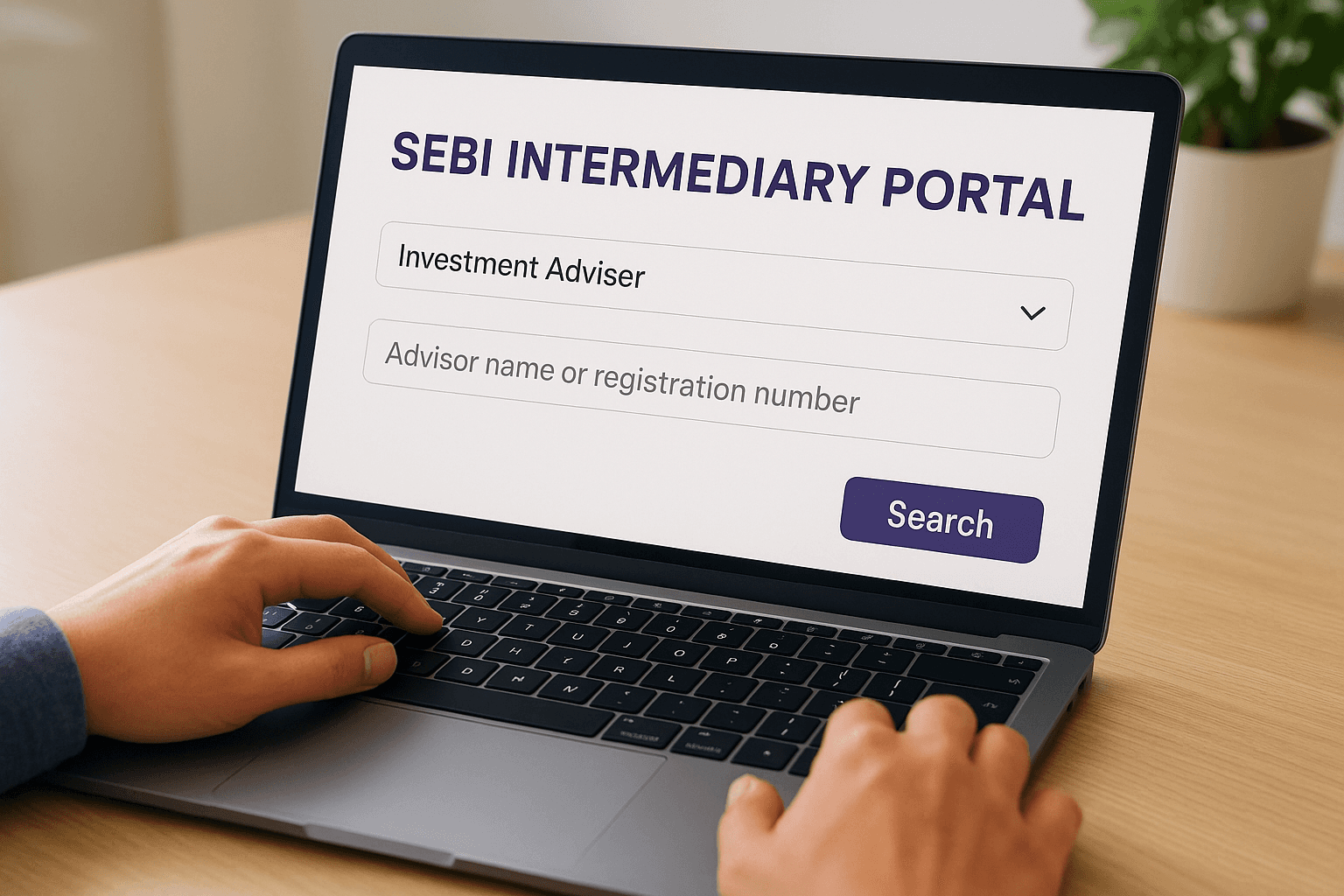
Always search the SEBI database directly rather than relying on credentials the advisor provides themselves.
Use this quick checklist when verifying:
Select "Investment Adviser" as the intermediary type
Enter the advisor's name or registration number
Confirm the status reads "Active"
Check that the validity period has not expired
What a valid registration entry tells you
A confirmed SEBI registered advisor listing displays their registration number (typically formatted as INA followed by digits), their registered address, validity dates, and entity type (individual or non-individual). Cross-check that registration number against the advisor's letterhead or website. If the number does not match or the registration has lapsed, do not proceed regardless of how credible their pitch sounds.
How SEBI registered advisors charge fees
Understanding how a SEBI registered advisor charges for their services helps you evaluate whether the arrangement makes financial sense for you. Unlike distributors who earn commissions that you never see as a line item, registered advisors must charge you directly and transparently, which makes cost comparison straightforward.
Flat fees and fixed retainers
Most individual registered advisors charge a flat annual fee or a fixed retainer for ongoing advisory services. You agree on a specific rupee amount upfront, and that amount does not change based on which funds or products the advisor recommends. This structure means their income stays completely disconnected from your product choices, so you get unbiased guidance throughout the year.
A flat fee model removes the single biggest source of bias in financial advice: the product commission.
Assets Under Advice fees
Some advisors, particularly those serving high-net-worth clients with larger portfolios, charge a percentage of assets under advice (AUA). SEBI regulations cap this at 2.5% per annum of AUA for individual advisors. While this model scales with your portfolio size, it still remains conflict-free because the advisor earns more only when your portfolio grows, not when they sell you a specific product.
You should always request a written fee agreement before engaging any advisor. A legitimate registered advisor will provide one without hesitation, and that document protects both parties throughout the advisory relationship.
How to become a SEBI registered advisor in India
Becoming a SEBI registered advisor requires meeting formal criteria set under the SEBI (Investment Advisers) Regulations, 2013. The registration process is structured, but it is straightforward if you meet the baseline requirements and follow the steps in order.
Eligibility and qualifications
To qualify, you need a postgraduate degree or diploma in finance, economics, business, or a related field from a recognized institution. Alternatively, a graduation degree combined with at least five years of relevant financial services experience satisfies the educational requirement. You must also clear NISM-Series-X-A and NISM-Series-X-B examinations, both of which test your knowledge of investment advisory practice and regulations. Individual applicants must maintain a net worth of at least Rs. 5 lakh, while non-individual entities require a minimum net worth of Rs. 50 lakh.
Meeting the qualification threshold is only the starting point; SEBI evaluates your overall fitness, including any prior regulatory actions against you.
Applying through the SEBI intermediary portal
You submit your application directly through SEBI's online registration portal at sebi.gov.in. Upload your educational certificates, NISM scores, and net worth documentation. SEBI reviews the submission and may seek clarifications before granting registration. Once approved, your registration certificate is issued and must be renewed periodically while you maintain full compliance with advisory regulations.
Key documents required for the application:
NISM-Series-X-A and X-B certificates
Educational qualification proof
Net worth certificate from a chartered accountant
Identity and address proof
Key takeaways
A SEBI registered advisor operates under a legal framework that protects your financial interests in ways that unregulated alternatives simply cannot. They charge transparent fees directly from you, hold a fiduciary duty to prioritize your goals, and face real regulatory consequences if they fail to deliver advice in your best interest. Verification takes under two minutes through SEBI's intermediary portal, and no legitimate advisor will resist that check.
The difference between regulated and unregulated advice compounds over time. Every year you spend with a commission-driven distributor costs you more than you see on paper. Choosing a conflict-free advisory service backed by SEBI oversight is one of the most straightforward financial decisions you can make. If you're ready to experience AI-powered, fiduciary-grade advice built around your goals, start your investment journey with Invsify today.