8 Wealth Accumulation Strategies For Indians In 2026
Shlok Sobti

8 Wealth Accumulation Strategies For Indians In 2026
Most Indians don't have a wealth problem, they have a strategy problem. Savings accounts, fixed deposits, and gold still dominate household portfolios, even though inflation has quietly eaten into their real returns year after year. If you're a salaried professional in India looking to actually build long-term wealth, you need wealth accumulation strategies that go beyond parking money and hoping for the best.
The good news? 2026 offers more accessible tools, better market infrastructure, and smarter ways to grow your net worth than any year before. From systematic investing and tax optimization to debt management and retirement planning, the building blocks are all there. What separates those who accumulate wealth from those who don't isn't income level, it's whether they follow a structured, informed approach. And that's exactly what this article breaks down for you.
We built Invsify, a SEBI Registered Investment Advisor powered by AI, because we saw too many Indians either relying on untrusted online tips or paying hidden commissions to distributors who don't have their best interests in mind. Every strategy in this list aligns with conflict-free, data-backed financial thinking, the kind we help our users apply every day through personalized insights and portfolio recommendations.
Here are eight actionable wealth accumulation strategies that Indian salaried professionals can start using right now.
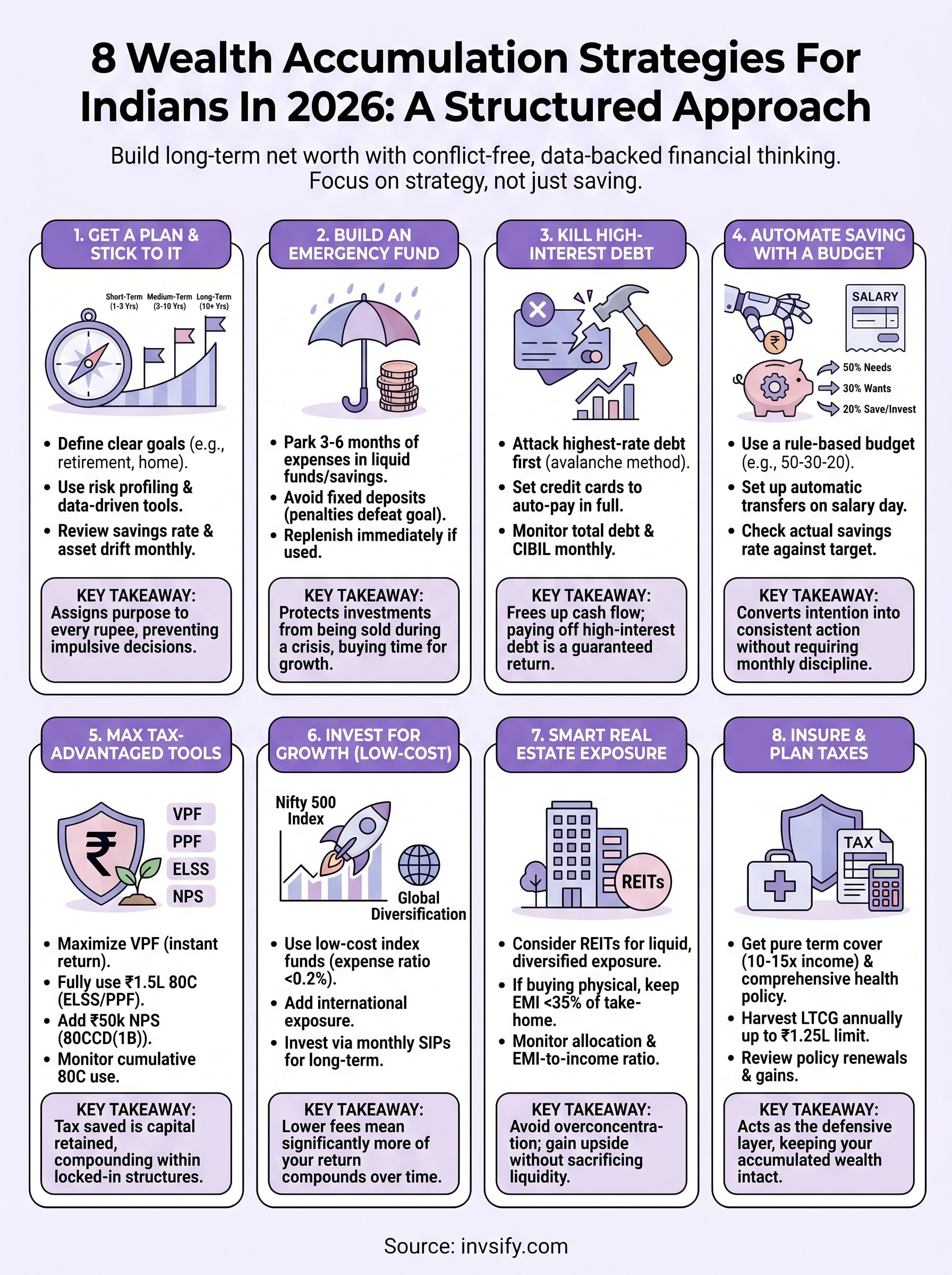
1. Get a plan with Invsify and stick to it
The most effective wealth accumulation strategies start with a financial plan, not a product. Most salaried Indians make decent money but never define where that money should go or what they want it to build over the next 10 to 20 years. Without a plan, every financial decision is a reaction, and reactions compound poorly.
Why this strategy works for wealth accumulation
A written financial plan forces you to assign purpose to every rupee. When you have clear goals tied to specific timelines, like retiring at 55 or buying a home by 32, your investing decisions become deliberate rather than impulsive. Invsify builds your plan around a personalized Wealth Wellness Score, a data-driven benchmark that shows exactly where your portfolio stands and what gaps need closing. This gives you a starting point grounded in your actual numbers, not generic advice.
A plan without a benchmark is just a wish list. Your Wealth Wellness Score tells you whether your current path actually leads where you want to go.
How to apply it in India in 2026
Start by completing Invsify's KYC and risk profiling process, which maps your income, liabilities, risk appetite, and goals into a structured roadmap. The AI then recommends specific instruments and target allocations suited to your profile. You don't need spreadsheets. The conversational RM AI is available 24/7 to adjust your plan as your life changes and flag when your portfolio drifts from its target allocation.
Your plan should cover at minimum:
Short-term goals (1 to 3 years): emergency fund, vacation, down payment
Medium-term goals (3 to 10 years): home purchase, children's education
Long-term goals (10+ years): retirement corpus, wealth transfer
What to track monthly to stay on course
Each month, review your savings rate (what you actually set aside versus what your plan calls for) and your asset allocation drift (whether your equity or debt holdings have shifted more than 5% from your target). Invsify's portfolio tracking surfaces both automatically, so this review takes minutes, not hours.
Common mistakes to avoid
The biggest mistake is treating the plan as a one-time task. Your income, tax situation, and goals shift every year, and your plan must reflect that. Also avoid making ad-hoc investments because a tip sounded convincing. Every off-plan rupee is a rupee that isn't working toward your actual financial future.
2. Build an emergency fund before you invest
Investing while sitting on zero liquidity is one of the fastest ways to undo your wealth accumulation strategies. A market dip, a job loss, or a medical emergency will force you to redeem your investments at exactly the wrong time, locking in losses instead of letting compounding do its job.
Why this strategy works for wealth accumulation
An emergency fund acts as a financial buffer that keeps your investments untouched when life goes sideways. Without it, every unexpected expense becomes a reason to break your SIPs or liquidate equity holdings at a loss. Your investments need time to grow, and a solid emergency fund buys them that time.
The goal isn't to earn returns on your emergency fund. The goal is to protect the returns on everything else.
How to apply it in India in 2026
Park 3 to 6 months of monthly expenses in a liquid mutual fund or a high-yield savings account. Avoid fixed deposits for this purpose since premature withdrawal penalties defeat the goal. If you're in a single-income household or a volatile industry, target the higher end of that range.
What to track monthly to stay on course
Check that your emergency fund balance stays above your target threshold as your expenses rise with inflation. If you dip into it, replenish it before resuming additional investments.
Common mistakes to avoid
Don't count your mutual fund SIPs or stocks as emergency money. Liquid and stable are the two non-negotiable criteria here, and equity meets neither on short notice.
3. Kill high-interest debt and protect your CIBIL
High-interest debt is the single biggest drain on any wealth accumulation strategy. Credit card balances rolling over at 36% to 42% annually, or personal loans at 18% to 24%, deliver guaranteed negative returns that no equity fund can consistently beat. Before you think about growing wealth, you need to stop the bleed.
Why this strategy works for wealth accumulation
Every rupee you pay in interest on high-cost debt is a rupee that can never compound for you. Eliminating this debt frees up cash flow that you can redirect into investments, and it also directly improves your CIBIL score, which determines the rates and terms you'll access for future borrowing like home loans.
Paying off a 36% credit card balance is the same as earning a guaranteed 36% return, no market risk attached.
How to apply it in India in 2026
List every debt with its outstanding balance and interest rate. Attack the highest-rate debt first while paying minimums on others (the avalanche method). Once clear, set credit card balances to auto-pay in full each month so you never pay revolving interest again.
What to track monthly to stay on course
Monitor your total outstanding debt balance and your CIBIL score monthly. Both should move in the right direction: one down, one up.
Common mistakes to avoid
Avoid taking a personal loan to invest in equity. The guaranteed interest cost will almost always outweigh the uncertain market return over short timeframes.
4. Automate saving with a rule-based budget
Most salaried Indians spend first and save whatever is left, which is why so little actually accumulates over time. A rule-based budget flips that equation by committing your saving and investing amounts upfront, before discretionary spending gets a chance to absorb them.

Why this strategy works for wealth accumulation
Automation removes the willpower variable from your finances. When your SIP deductions and savings transfers happen automatically on salary day, you never see that money as available to spend. This is one of the most underrated wealth accumulation strategies because it converts intention into consistent action without requiring discipline on your part every single month.
The best saving system is the one that works even on your worst days.
How to apply it in India in 2026
Use the 50-30-20 rule as your starting framework: 50% of take-home pay for needs, 30% for wants, and 20% for savings and investments. Set up standing instructions and SIP mandates on the day your salary hits, so transfers happen before you can redirect that money elsewhere.
What to track monthly to stay on course
Check your actual savings rate against your target each month. If expenses crept up and pushed your savings below 20%, identify which category exceeded its limit and course-correct the following month before the shortfall compounds into a habit.
Common mistakes to avoid
Don't set a budget once and leave it untouched for years. Your salary will grow and your fixed expenses will shift, so revisit your allocations at least twice a year to keep your savings rate moving in the right direction.
5. Max out EPF, PPF, NPS, and ELSS wisely
India's tax-advantaged retirement instruments are among the most powerful wealth accumulation strategies available to salaried professionals, yet most people use them reactively as tax-saving tools rather than proactively as compounding engines.

Why this strategy works for wealth accumulation
EPF, PPF, NPS, and ELSS combine tax savings with long-term compounding inside structures that discourage early withdrawal. The lock-in periods aren't a drawback, they're the feature. Keeping your money invested through market cycles is where real corpus growth happens, and these instruments enforce exactly that.
Tax saved is capital retained, and retained capital compounds while tax paid does not.
How to apply it in India in 2026
Maximize your EPF voluntary contribution (VPF) first since the employer match gives you an instant return. Then fully use your Section 80C limit of Rs 1.5 lakh across PPF and ELSS, prioritizing ELSS for equity growth if your timeline exceeds five years. Add NPS Tier 1 contributions to capture the additional Rs 50,000 deduction under Section 80CCD(1B).
VPF: best for conservative, guaranteed-return allocation
PPF: 15-year lock-in, government-backed, tax-free maturity
ELSS: 3-year lock-in, equity-linked, highest growth potential
NPS: retirement-focused, additional tax benefit, partial annuity at exit
What to track monthly to stay on course
Monitor your cumulative 80C utilization by October each year so you're not scrambling in March with rushed decisions.
Common mistakes to avoid
Avoid buying insurance-linked investment products to fill your 80C limit. They deliver poor returns and lock you in for longer than any of the instruments above.
6. Invest for growth with low-cost diversified funds
Once your tax-advantaged accounts are funded, excess savings need to work harder in the open market. Low-cost index funds and diversified equity mutual funds are the most reliable vehicles for long-term wealth accumulation strategies available to Indian retail investors today.
Why this strategy works for wealth accumulation
Most actively managed funds fail to consistently beat their benchmark index over a 10-year period after fees. A low-cost index fund tracking the Nifty 50 or Nifty 500 captures broad market returns while keeping your expense ratio below 0.2%, meaning more of your return stays in your account rather than funding a fund manager's salary.
The difference between a 1.5% and a 0.2% expense ratio compounds into lakhs over a 20-year investment horizon.
How to apply it in India in 2026
Start with a Nifty 500 index fund for domestic broad-market exposure, then add a Nasdaq 100 or global fund for international diversification. Keep your total equity allocation aligned with the risk profile from your Invsify plan, and invest through monthly SIPs rather than lump sums to reduce timing risk.
What to track monthly to stay on course
Review your portfolio's overall expense ratio each month and check whether your actual equity allocation has drifted beyond 5% of your target. Both numbers surface automatically inside your Invsify portfolio dashboard.
Common mistakes to avoid
Avoid chasing last year's top-performing funds. Rotating into recent winners consistently underperforms a steady, low-cost index strategy held through full market cycles.
7. Add real estate exposure without overbuying
Real estate dominates the Indian investor's mindset, often to the point where a single property purchase absorbs the entire investable surplus for a decade. Owning physical property has its place, but treating it as your only wealth accumulation strategy leaves your portfolio dangerously illiquid and concentrated.
Why this strategy works for wealth accumulation
Real estate provides inflation-hedged returns and portfolio diversification, two qualities that complement equity and debt holdings well. The problem isn't the asset class; it's the overconcentration. Spreading real estate exposure across instruments rather than sinking everything into one physical property gives you the upside without sacrificing liquidity.
Exposure to real estate and overexposure to a single property are two very different financial positions.
How to apply it in India in 2026
REITs (Real Estate Investment Trusts) listed on Indian exchanges let you invest in commercial real estate with as little as a few thousand rupees and full liquidity. If you're buying physical property, ensure the EMI stays below 35% of your take-home pay and that you're not delaying equity SIPs to fund the down payment.
What to track monthly to stay on course
Monitor your real estate allocation as a percentage of your total net worth and your EMI-to-income ratio monthly. Both numbers should stay within your Invsify plan's defined thresholds.
Common mistakes to avoid
Avoid treating an under-construction property as a guaranteed appreciating asset. Delays, legal disputes, and illiquidity have derailed many otherwise solid financial plans.
8. Insure and plan taxes to keep wealth intact
Building wealth and keeping it are two separate challenges. Without adequate insurance and smart tax planning, a single medical emergency or an inefficient tax structure can undo years of disciplined investing. These two elements are the defensive layer that every wealth accumulation strategy needs to stay intact over the long run.
Why this strategy works for wealth accumulation
Term insurance and health insurance protect your corpus from being liquidated during a crisis. A ₹1 crore term cover for a 30-year-old costs less than ₹10,000 a year and ensures your family's financial plan survives even if you don't. Tax planning, done proactively, keeps more of your investment returns compounding instead of flowing out as avoidable tax liability.
Insurance isn't an investment, it's the wall that stops a single bad event from erasing everything you built.
How to apply it in India in 2026
Get a pure term insurance plan with a cover of at least 10 to 15 times your annual income and a comprehensive family floater health policy with a sum insured of at least ₹10 lakh. On the tax side, harvest long-term capital gains up to the ₹1.25 lakh annual exemption limit each financial year to reset your cost basis and reduce future tax liability.
What to track monthly to stay on course
Review your insurance premiums and policy renewal dates quarterly. Track your realized capital gains each month so you don't cross the LTCG threshold accidentally.
Common mistakes to avoid
Avoid mixing insurance with investment by buying ULIPs or endowment plans. Pure term cover costs a fraction of the price and leaves your invested capital working in instruments that actually grow your wealth.
Your next move
Eight strategies, one clear thread: wealth accumulation requires structure, not luck. You now have a framework that covers every layer, from emergency liquidity and debt elimination to tax-advantaged investing, diversified growth, and protection. None of these strategies work in isolation. They compound on each other, and the faster you start stacking them, the more time they have to work.
The hardest part isn't knowing what to do. Acting on it consistently, while your income changes, markets move, and life throws surprises, is where most people fall short. That's exactly the gap Invsify was built to close. Your Wealth Wellness Score gives you a real-time read on where you stand, and our AI-powered advisory keeps your plan calibrated without the conflicts of interest that come with traditional distributors.
Put these wealth accumulation strategies into motion today. Get your personalized wealth plan on Invsify and start building with a plan that's built around your actual numbers.