6 Wealth Preservation Strategies For Salaried Indians
Shlok Sobti

6 Wealth Preservation Strategies For Salaried Indians
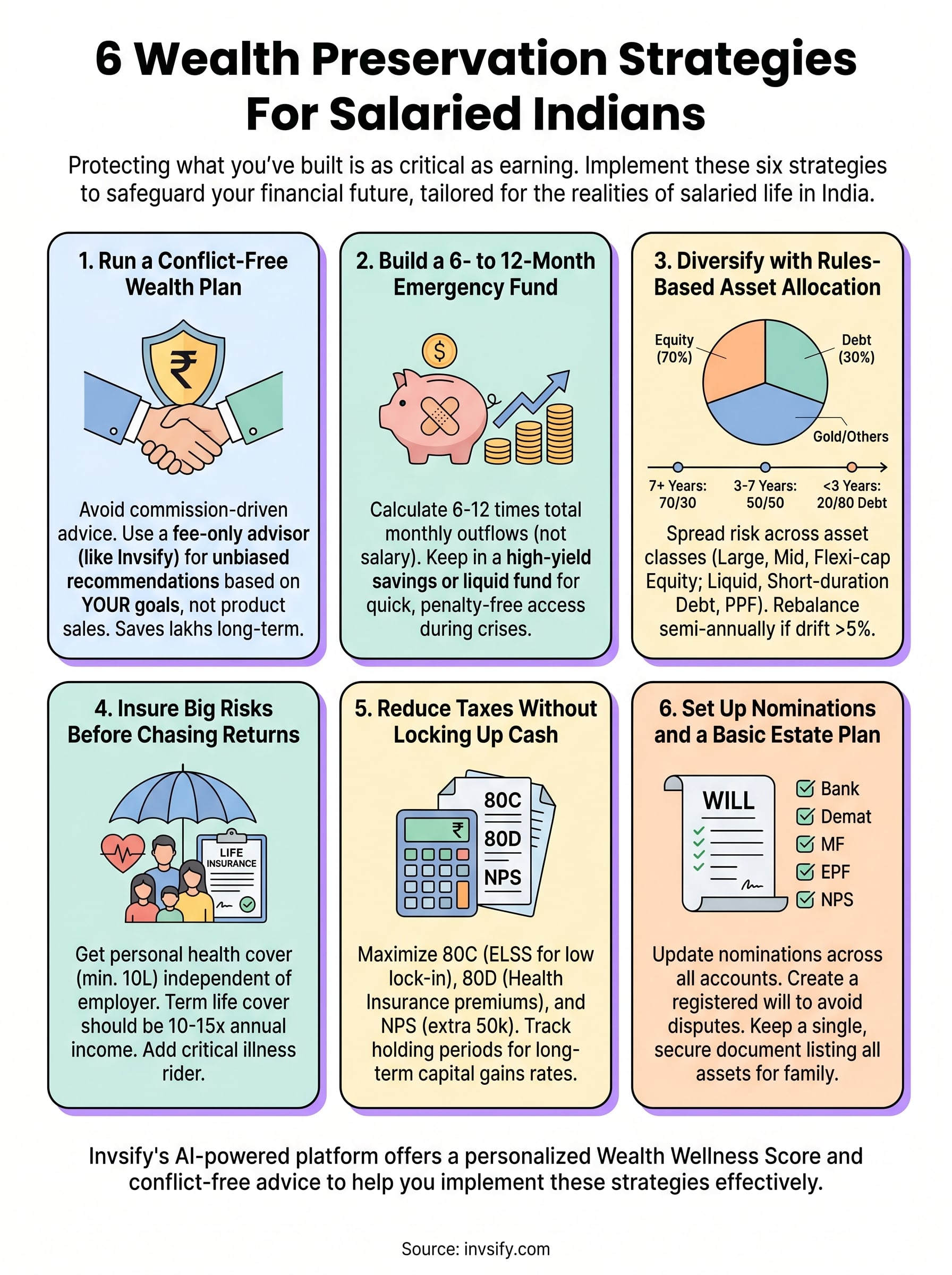
Building wealth as a salaried professional in India is hard enough. Between taxes, inflation, and market volatility, keeping that wealth intact is a different challenge altogether. That's exactly why wealth preservation strategies matter, not just for HNIs or retirees, but for anyone with a growing corpus they can't afford to lose.
The reality is, most salaried Indians focus almost entirely on earning and investing, while ignoring the systems that protect what they've already built. A single unplanned tax liability, an inadequate insurance cover, or a poorly diversified portfolio can erode years of disciplined saving. And the generic advice floating around online forums? It rarely accounts for your specific financial situation.
At Invsify, our AI-powered advisory platform helps salaried Indians make smarter, conflict-free decisions, not just about growing wealth, but about protecting it. This article breaks down six actionable strategies you can use to safeguard your hard-earned money, from diversification and tax optimization to estate planning and insurance. Each one is tailored to the realities of salaried life in India, so you can act on them right away.
1. Use Invsify to run a conflict-free wealth plan
Most financial advice in India comes from distributors who earn commissions based on what they sell you, not what suits you. That creates a structural conflict that quietly works against your wealth preservation strategies. Invsify operates as a SEBI Registered Investment Advisor, which means it charges fees for advice, not commissions for pushing products.
What this strategy protects you from
Commission-driven advice pushes you toward high-expense-ratio funds and products that pad the distributor's income. You end up paying hidden fees that compound against your portfolio year after year. Invsify's conflict-free model removes that incentive entirely, so every recommendation it makes is based on your financial goals and risk profile, not someone else's earnings.
Switching from a commission-based distributor to a fee-only advisor can save lakhs over a 10-15 year horizon, purely from reduced expense ratios and better product selection.
How to set it up in the first 30 days
Start by completing your KYC and risk profiling on the Invsify platform, which takes under 30 minutes. The AI then generates a personalized Wealth Wellness Score that tells you exactly where your portfolio stands today.
In weeks two through four, review the gaps it flags, whether that is under-insurance, poor asset allocation, or avoidable tax drag. By day 30, you should have a clear, written plan with specific next actions.
What to review every month and every year
Each month, check your portfolio performance and asset allocation drift using Invsify's tracking tools. The platform delivers personalized weekly insights so you stay informed between formal reviews.
Annually, revisit your risk profile, update your income and tax situation, and confirm that your nominations and insurance covers still reflect your current life stage.
Costs, fees, and what to watch for
Invsify charges a transparent advisory fee with no hidden commissions layered on top. Before signing up, run the Hidden Fee Calculator on the platform to see exactly how much traditional distributors have cost you over time.
Avoid platforms that market themselves as "free" but earn through product commissions
Ask any advisor directly: do you earn trail commission on the funds you recommend?
Compare total expense ratios before and after switching to a fee-only model
2. Build a 6- to 12-month emergency fund
An emergency fund is one of the most practical wealth preservation strategies you can put in place, yet most salaried Indians skip it or underfund it badly. Without a liquid buffer, a single unexpected event like job loss, a medical bill, or an urgent home repair forces you to liquidate investments at the worst possible time, destroying compounding you spent years building.
What this strategy protects you from
A missing emergency fund turns short-term cash problems into long-term portfolio damage. You end up breaking fixed deposits before maturity, redeeming equity funds at a loss, or taking personal loans at high interest rates that eat into your net worth for months after the original emergency has passed.
How to calculate the right emergency fund size
Multiply your total monthly outflows (rent, EMIs, groceries, utilities, and insurance premiums) by six at minimum. If you are the sole earner in your household or work in a sector prone to layoffs, stretch that number to 12 months to give yourself a genuine runway.
A common mistake is basing the target on your salary rather than your actual spending. Use real monthly outflows as your baseline, not your take-home pay.
Where to keep the money in India
Split the fund between a high-yield savings account for immediate access and a short-term liquid mutual fund for the remaining portion. Both instruments offer same-day or next-day redemption without locking up your capital or exposing it to market risk.
Mistakes that quietly break this safety net
Parking your entire buffer in equity mutual funds defeats the purpose since markets often fall hardest exactly when personal emergencies hit. Beyond that, avoid treating the account as a lifestyle or travel fund between crises, because the moment you dip into it casually, you lose the protection it was built to provide.
3. Diversify with a rules-based asset allocation
Spreading your money across multiple asset classes is one of the most reliable wealth preservation strategies available to salaried investors. A rules-based approach sets fixed percentage targets upfront, so market swings don't push you into emotionally driven decisions.
What this strategy protects you from
Concentration risk is the core problem. When one asset class drops sharply, a single-asset portfolio absorbs the full loss with no buffer. Diversification limits that damage so a bad quarter in equity doesn't force you to liquidate your entire corpus at the worst moment.
Behavioral mistakes compound that damage further. Panic-selling during a downturn turns a temporary paper loss into a permanent one. A pre-set allocation gives you a clear anchor so you know exactly when to hold and when to act.
How to pick an equity-debt split by time horizon
Match your equity percentage directly to your goal timeline. Longer goals tolerate more equity volatility since you have time to recover before you actually need the money.

7+ years: 70% equity, 30% debt
3-7 years: 50% equity, 50% debt
Under 3 years: 20-30% equity, 70-80% debt
How to diversify within equity and within debt
Within equity, spread across large-cap index funds, mid-cap funds, and flexi-cap funds rather than concentrating in a single theme or sector. Within debt, combine liquid funds for short-term needs with short-duration funds and PPF for medium-term stability.
Avoid loading up on thematic or sectoral funds as a diversification move. They concentrate risk rather than spreading it.
How to rebalance without overtrading
Review your split every six months and rebalance only when a class drifts more than five percentage points from its target. This caps tax liability and transaction costs while keeping your portfolio aligned to the plan you built.
4. Insure big risks before chasing returns
Insurance is not a financial product you buy after sorting out your investments. It is the foundation that keeps your portfolio from getting wiped out by a single large event. Salaried Indians often underinsure because they rely on employer-provided group cover, which disappears the moment they switch jobs or face a layoff.
What this strategy protects you from
A medical emergency without adequate health cover can drain an entire year's savings in a matter of weeks. Without term life cover, your family's financial future depends entirely on your continued earning capacity, which is never guaranteed.
Underinsurance is one of the most common yet overlooked threats to long-term wealth preservation strategies for salaried households.
Health insurance moves that prevent portfolio damage
Buy a personal health insurance policy independent of your employer's group plan, with a minimum cover of 10 lakhs for individuals and more for families. Add a super top-up plan to extend coverage without a proportionate increase in premium cost.
Term life and disability cover for salaried households
Your term cover should be at least 10 to 15 times your annual income. Include a critical illness or disability rider since losing your earning ability without dying is often the larger financial risk for working professionals.
Liability cover and add-ons people skip
Personal accident cover and home insurance are two add-ons most salaried earners ignore entirely. Both are inexpensive relative to the financial exposure they protect against, making them high-value purchases for a low annual outlay.
5. Reduce taxes without locking up cash
Tax drag quietly compounds against your portfolio every year, making tax optimization one of the most underused wealth preservation strategies for salaried professionals in India. The goal is to reduce what you owe without parking money in illiquid instruments that limit your financial flexibility.
What this strategy protects you from
Unnecessary tax outflows directly reduce your investable surplus, slowing compounding over decades. Poor planning also creates surprise tax bills at year-end, forcing you to liquidate investments you intended to hold long-term.
Paying even 5% more in taxes than required every year can cost you significantly more in lost compounding over a 15-year horizon.
How to use 80C, 80D, and other common deductions
Max out Section 80C up to ₹1.5 lakh annually using ELSS funds rather than traditional instruments, since ELSS carries only a 3-year lock-in and historically delivers equity-level returns. Claim Section 80D for health insurance premiums for yourself, your spouse, and your parents to reduce your taxable income further.
How to think about NPS, PF, and debt funds for taxes
NPS contributions under Section 80CCD(1B) offer an additional ₹50,000 deduction beyond 80C limits. Your EPF contributions already shelter a portion of your salary from tax each month, so factor that in before adding more illiquid instruments to your plan.
How to avoid tax traps in switches, redemptions, and gains
Switching between mutual fund schemes triggers a taxable event even if you stay within the same fund house. Track your holding periods carefully to qualify for long-term capital gains rates rather than short-term rates, which are significantly higher and can noticeably reduce your net returns.
6. Set up nominations and a basic estate plan
Most salaried Indians treat nominations and estate planning as tasks they'll handle "later," but later rarely comes until there's a crisis. Without the right paperwork in place, your family can spend months and significant legal fees accessing money that was always meant to be theirs, which makes this one of the most overlooked wealth preservation strategies for working professionals.
What this strategy protects you from
Poor estate planning creates legal disputes, frozen accounts, and delayed asset transfers at exactly the moment your family needs financial stability most. A missing or outdated nomination can force your spouse or children into lengthy court proceedings to claim even basic savings.
A nomination does not override a will in all cases, so having both in place gives your family a much clearer path to your assets.
Nomination checklist across bank, demat, MF, EPF, NPS
Each financial account carries its own nomination record, and they all need to be updated independently whenever your life situation changes.

Bank savings and FD accounts: Update nominations through net banking or branch
Demat account: Update through your broker's portal
Mutual fund folios: Submit a nomination form with each AMC or through your platform
EPF and NPS: Update through EPFO portal and your NPS CRA respectively
When a will matters even for salaried investors
A registered will overrides informal arrangements and removes ambiguity about your intentions. Even a straightforward estate benefits from a will once you hold property, financial assets, or have dependents relying on a specific distribution plan.
How to organize documents so your family can act fast
Keep a single, updated document listing every account, policy number, folio, and login location. Store it securely and share its physical location with at least one trusted family member so they can act without guesswork.
Next steps
These six wealth preservation strategies work best when you treat them as a system rather than a checklist. Each one reinforces the others: your emergency fund protects your investments, your insurance protects your income, your tax planning keeps more money working for you, and your estate plan ensures all of it reaches the right people. Skipping even one layer leaves a gap that can undo years of disciplined effort.
The clearest starting point is knowing exactly where your portfolio stands today. Invsify's AI-powered platform gives you a personalized Wealth Wellness Score, flags the specific gaps in your current setup, and delivers conflict-free recommendations without any commission-driven bias. You get 24/7 access to financial guidance, portfolio tracking, and weekly insights built around your actual situation, not a generic template.
Start protecting what you have built. Get your Wealth Wellness Score on Invsify and take the first step toward a plan that actually holds up.