Educational only; not a recommendation to buy any form of gold.
Summary
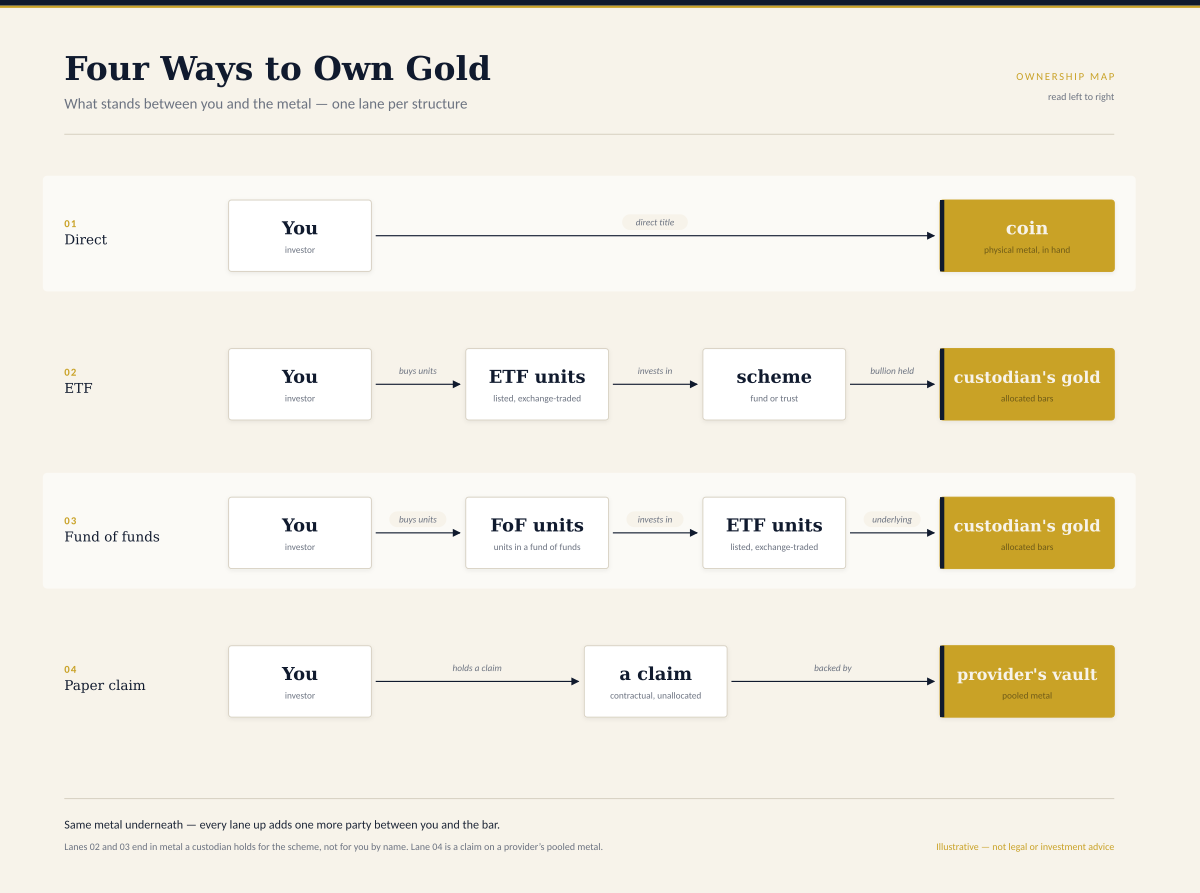
“Buying gold” can mean four different products. Coins and bars are the metal itself. A gold ETF is a mutual fund unit traded on the stock exchange, backed by physical gold. A gold fund of funds is a mutual fund that holds gold ETF units. Digital gold is a claim on metal held by a private provider, outside SEBI’s rules.
Dhanteras falls on Friday, 6 November this year. If you’re buying Dhanteras gold, or weighing a gold ETF vs digital gold on your phone, the word “gold” on the receipt can mean four different things. Here is what you own in each, what you pay, how it’s taxed and what to ask first.
Four ways to “buy gold”
- Coins and bars (physical gold). You own the metal. You pay for the gold, a making charge or premium and GST, and you look after it yourself.
- A gold ETF. You own units of a mutual fund scheme traded on the stock exchange. The scheme holds physical gold of 99.5% purity or above and tracks the domestic gold price. You need a demat and a trading account.
- A gold fund of funds (FoF). You own units of a mutual fund scheme that invests in a gold ETF. You buy and sell at the day’s NAV, need no demat account, and can invest through a SIP.
- Digital gold. You own a claim on gold that a private provider buys and stores in its vault for you. You buy it in rupee amounts through an app. It is not a security, and SEBI does not regulate it.
What you own in each
| Coins and bars | Gold ETF | Gold fund of funds | Digital gold | |
|---|---|---|---|---|
| What you own | The metal itself | Units of a mutual fund scheme listed on the exchange | Units of a mutual fund scheme that holds gold ETF units | A claim on gold held by a private provider |
| Who oversees it | The BIS hallmark shows purity; a coin isn’t a financial product | SEBI, under its mutual fund rules | SEBI, under its mutual fund rules | Not SEBI: it says these products are outside its purview |
| Where the gold sits | With you, at home or in a locker | With the scheme’s custodian; your units sit in your demat account | With the ETF’s custodian; your units sit in your mutual fund folio | In the provider’s vault |
| How you sell | To a jeweller or dealer, at their buyback rate | On the exchange, at the market price | To the fund house, at the day’s NAV | In the provider’s app, at its sell price |
| Demat account needed | No | Yes | No | No |
Gold ETF vs digital gold: the difference that matters most
Both let you buy small amounts of gold from your phone. The difference is what stands behind your purchase. A gold ETF runs under SEBI’s mutual fund rules, from how the gold is held to what the scheme must disclose, and your units sit in your own demat account.
With digital gold, you hold a claim on the provider. In a caution issued on 8 November 2025, SEBI said digital gold is neither a notified security nor a regulated commodity derivative, so it sits wholly outside SEBI’s regulation. It flagged counterparty and operational risk, and said the investor protections for securities don’t extend to these products. In September 2026, reports said the government was discussing rules for digital gold; none had been finalised.
Costs: what you pay beyond the gold price
Coins and bars
- 3% GST on the purchase
- A making charge or premium on top of the gold’s value (jewellery: making charges, plus 5% GST on them)
- A locker and insurance, if you don’t keep it at home
- A deduction when you sell; some sellers don’t buy back, so ask first
Gold ETF
- An annual expense ratio, taken from the scheme’s value
- Brokerage and exchange charges on every trade, plus demat charges
- Any gap between your trade price and the scheme’s NAV, which can widen when trading is thin
Gold fund of funds
- Two layers of annual expenses, the fund’s own and the ETF’s; read both in the factsheet
- An exit load in some schemes if you sell early
- A higher expense ratio in a regular plan than in a direct plan, because it includes a distributor’s commission (see what that commission costs)
Digital gold
- 3% GST on the purchase
- The gap between the provider’s buy and sell prices
- Storage terms that vary by provider: how long it holds your gold, and the charge after that
- Making and delivery charges if you convert to coins or bars
Tax basics for 2026-27: STCG and LTCG
When you sell gold for more than you paid, the profit is a capital gain. How long you held it decides whether it’s a short-term capital gain (STCG), added to your income and taxed at your slab rate, or a long-term capital gain (LTCG), taxed at a flat 12.5% without indexation. The rules for the tax year 2026-27:
| Form of gold | STCG if held for | STCG tax | LTCG if held for | LTCG tax |
|---|---|---|---|---|
| Coins, bars and jewellery | 24 months or less | Your income-tax slab rate | More than 24 months | 12.5%, no indexation |
| Digital gold | 24 months or less | Your slab rate | More than 24 months | 12.5%, no indexation |
| Gold ETF | 12 months or less | Your slab rate | More than 12 months | 12.5%, no indexation |
| Gold fund of funds | 24 months or less | Your slab rate | More than 24 months | 12.5%, no indexation |
Surcharge and cess apply on top of both. GST is charged when you buy coins, bars or digital gold, not on fund units. To work out the tax on a sale, use our capital gains tax calculator. Tax rules change, so check the rules in force, or ask a tax professional, before you sell.
Questions to ask before you pay
- What exactly will I own? Metal, units of a regulated fund, or a claim on a provider?
- Who oversees it, and where is the gold kept?
- What do I pay on top of the gold price? GST, making charges, expense ratios, brokerage, the buy-sell gap.
- How do I sell, and at what price? A buyback rate, the exchange price, the NAV or the app’s sell price.
- When does a gain become long-term? After 12 months for a gold ETF; 24 months for the rest.
- For coins and jewellery, what does the hallmark say? Look for the BIS mark, the purity grade (for example, 22K916) and, where there is one, the six-digit HUID, which you can check in the BIS CARE app. Keep an invoice that states weight and purity.
- For a gold fund of funds, regular or direct plan? If someone is selling it to you, ask how they are paid (who is paid to advise you).
- Where does this sit in the rest of my money? Gold is one part of a portfolio. Decide the amount before you reach the counter.
Frequently asked questions
Gold ETF vs digital gold: which one does SEBI regulate?
Only the gold ETF, which is a mutual fund scheme. In its caution of 8 November 2025, SEBI said digital gold is neither a security nor a regulated commodity derivative, so securities-market investor protections don't apply to it.
What is the difference between a gold ETF and a gold fund of funds?
Both are SEBI-regulated mutual fund schemes. A gold ETF trades on the exchange and needs a demat account. A gold fund of funds holds a gold ETF, trades at NAV, needs no demat and allows SIPs, with two layers of expenses.
Do I need a demat account to buy gold?
Only for a gold ETF, which you buy through a broker on the stock exchange. A gold fund of funds, digital gold, coins and bars don't need one.
How is gold taxed when I sell it in 2026-27?
Gains on a gold ETF held over 12 months, or on a gold fund of funds, digital gold or physical gold held over 24 months, are long-term capital gains (LTCG), taxed at 12.5% without indexation. Gains on gold sold sooner are short-term capital gains (STCG), taxed at your slab rate. Surcharge and cess apply on top of both.
Can I still buy Sovereign Gold Bonds?
No new Sovereign Gold Bonds have been issued since February 2024; existing ones trade on BSE and NSE. From 1 April 2026, gains at redemption are tax-free only on bonds bought at issue and held to maturity.
Read the product before you buy
Same word, four products. Before you pay this Dhanteras, check what you’ll own, what it costs to hold and sell, and how the gain will be taxed.
If you’d like a SEBI-registered adviser who is paid only by you to look at where gold sits in your whole portfolio, book a 30-minute call. Your first call with an adviser is free, with no obligation.
Disclosure
Invsify Technologies Private Limited is a SEBI-registered Investment Adviser, Registration No. INA000020572; BASL enlistment ID 2286; CIN U66190DL2025PTC444097. Registered office: F-33/3, 2nd Floor, Phase 2, Okhla Industrial Estate, New Delhi 110020. Principal Officer: Mohana Pradeesh T T. Compliance Officer: Vineet Parashar, +91 22 6933 1660, [email protected]. Grievances: [email protected], then SEBI SCORES and Smart ODR.
This article is for education only. It is not investment advice or a recommendation to buy, sell or hold any form of gold or any security, and it names no product. Tax rules are summarised as of 2 November 2026 and can change.
Investment in securities market are subject to market risks. Read all the related documents carefully before investing.
Registration granted by SEBI, membership of BASL and certification from NISM in no way guarantee performance of the intermediary or provide any assurance of returns to investors.