Educational only; not a recommendation to buy, sell or switch any fund.
Regular vs direct mutual funds: the short answer
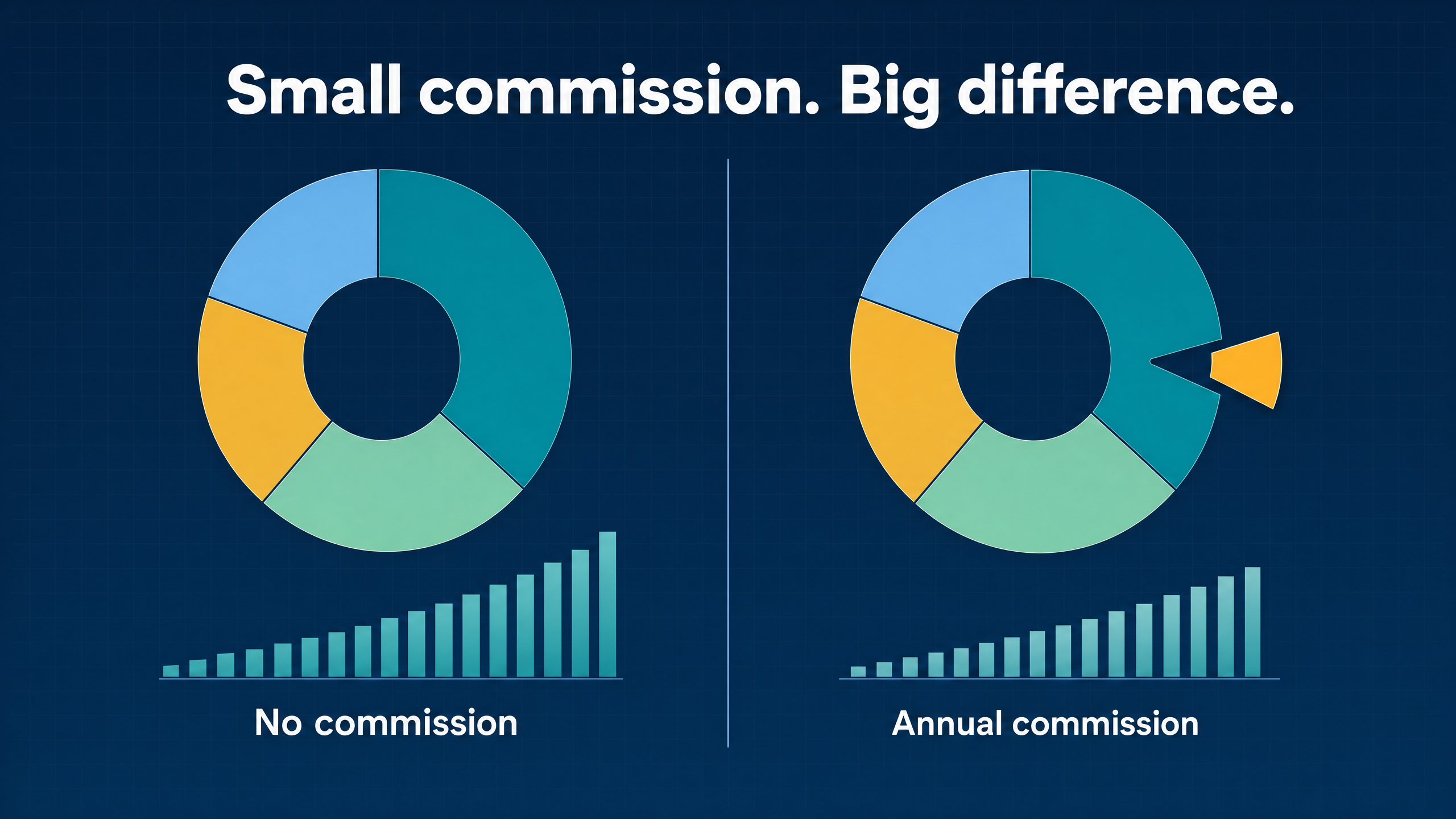
A regular plan and a direct plan are two versions of the same mutual fund scheme. They hold the same shares and bonds, have the same fund manager and carry the same risk. The difference is cost: a regular plan pays a distributor a commission every year out of the scheme’s assets, so its expense ratio is higher and its returns are lower by the same margin. A direct plan pays no commission.
The yearly gap looks small, but it compounds. In the illustration further down, a gap of one percentage point a year on ₹10 lakh grows to about ₹9.9 lakh over 20 years.
The question is more pressing this month. From 1 November 2026, direct plans are the default on fund houses’ own websites and apps, and anyone who picks a regular plan there must be told it costs more (Business Standard). Existing investments and SIPs don’t move on their own, and regular plans still held about 55% of the industry’s assets in March 2026, even though the share of retail money in direct plans rose from 21.4% to 36.7% in five years (Business Standard). Many families who started investing through a bank, an agent or a relative never chose a plan at all.
In this guide:
- What regular and direct plans are
- Where the expense ratio difference comes from
- What the gap adds up to on ₹10 lakh
- How to check if your mutual fund is direct or regular
- Whether to switch, and which route suits you
- Frequently asked questions
What is a regular plan and what is a direct plan?
A regular plan is a scheme you buy through a distributor, who earns a yearly commission from it; a direct plan is the same scheme with no commission (SEBI circular, 2012).
| How you invest | Plan you hold | How the person helping you is paid |
|---|---|---|
| Through a mutual fund distributor (bank, agent, commission-earning app) | Regular | A trail commission from the fund house, built into the scheme’s expense ratio |
| On your own, through the fund house or a platform that takes no commission | Direct | No one; you do the research and the paperwork yourself |
| With a SEBI-registered investment adviser | Direct | A fee you pay the adviser openly, which does not come out of the fund |
Where the expense ratio difference comes from
You never write a cheque for a mutual fund’s expenses. The fund house deducts a small slice of the scheme’s assets every day before it declares the NAV, so the cost shows up only as slightly slower growth. That slice is the total expense ratio (TER), and the commission in a regular plan sits inside it. (New to the term? Start with what an expense ratio is.)
How SEBI’s 2026 rules build the expense ratio
The SEBI (Mutual Funds) Regulations, 2026, which replaced the 1996 rules from 1 April 2026, split the cost into parts (SEBI (Mutual Funds) Regulations, 2026). The fund manager’s fee, distribution expenses and commission, and the scheme’s other running costs come out of the base expense ratio, which has a ceiling that falls as a scheme grows. Statutory levies such as GST, STT and stamp duty are now charged separately, on top of it (Outlook Money), and so are capped brokerage and transaction costs. Those extras are broadly the same for both plans, so the gap between regular and direct sits inside the base expense ratio.
| Open-ended equity scheme size (daily net assets) | Maximum base expense ratio |
|---|---|
| First ₹500 crore | 2.10% |
| Next ₹250 crore | 1.90% |
| Next ₹1,250 crore | 1.60% |
| Next ₹3,000 crore | 1.50% |
| Next ₹5,000 crore | 1.40% |
| Next ₹40,000 crore | Falls by 0.05% for every ₹5,000 crore |
| Above that | 0.95% |
Source: SEBI (Mutual Funds) Regulations, 2026. Debt and other schemes have lower ceilings, starting at 1.85%, and index funds and ETFs have a flat ceiling of 0.90%.
Two things in this structure matter for you. The first is that these are ceilings, not prices. Each fund house sets its own expense ratios below them, and a regular plan’s ratio is higher than the direct plan’s mainly by the distribution cost built into it. The second is that the commission is a trail: the fund house keeps paying it to your distributor for as long as your money stays in the regular plan, as a percentage of what your investment is worth. As your investment grows, so does the commission paid out of it, year after year, whether or not anyone has reviewed your portfolio with you.
The same structure explains why the gap is usually widest in actively managed equity funds, which have the highest ceilings, and smallest in index funds, whose whole base expense ratio is capped at 0.90%.
Who receives the commission
Fund houses paid distributors ₹27,335 crore in commission in 2024-25, according to an analysis of AMFI disclosures reported by Business Today (Business Today). Banks earned the most per entity, wealth managers and corporate distributors took more than 42% of the pool, and the 1,474 individual distributors in the disclosure earned ₹2,689 crore between them. None of this is improper: distribution is a legitimate, regulated service. The point is simply that you pay for it, so you should know how much and decide whether you’re getting your money’s worth.
You can see your own share. Since October 2016, SEBI has required the half-yearly consolidated account statement (CAS) to show, for each scheme you hold, the commission paid to distributors on your investment in rupees, along with the plan’s average expense ratio (Business Standard). The number is already sitting in a document most people never open.
What the gap adds up to on ₹10 lakh
A difference of half a percentage point or one point a year sounds too small to worry about, which is exactly why it’s easy to ignore. The trouble is that it is taken from a growing amount every year, and the money it removes stops compounding for you.
To see the effect, imagine ₹10 lakh invested once in the same scheme, with the portfolio growing at an assumed 10% a year before costs. The direct plan’s expense ratio is taken as 0.7%, and the regular plan’s as either 0.5 or 1 percentage point higher. These numbers are purely for arithmetic, not a forecast of any fund’s return.
| Holding period | Direct plan (0.7% a year) | Regular plan, 0.5 point higher | Regular plan, 1 point higher |
|---|---|---|---|
| 10 years | about ₹24.3 lakh | about ₹23.2 lakh (₹1.1 lakh less) | about ₹22.2 lakh (₹2.1 lakh less) |
| 20 years | about ₹59.2 lakh | about ₹54.0 lakh (₹5.2 lakh less) | about ₹49.3 lakh (₹9.9 lakh less) |
The pattern matters more than the exact figures. Over ten years, a one-point gap leaves you with roughly 9% less money; over twenty years, roughly 17% less, because the gap compounds rather than simply adding up. Doubling the holding period roughly doubles the share of your wealth that goes to costs.
SIPs follow the same pattern. Business Standard’s worked example of a ₹10,000 monthly SIP over 20 years, at an assumed 12% a year before costs, put the direct plan about ₹9.5 lakh ahead of the regular plan on the same ₹24 lakh invested, and the paper stressed that its figures are indicative (Business Standard).
To see the gap for your own money, use our regular vs direct calculator. Enter what you hold in regular plans and your monthly SIP, or look up a fund to use its actual expense ratio gap; it needs no sign-up to show the answer. Each plan’s expense ratio is listed on AMFI’s TER page and in the fund’s monthly factsheet.
How to check if your mutual fund is direct or regular
Most people can find the answer in about ten minutes, without calling anyone. The simplest source is your consolidated account statement (CAS), which lists every mutual fund you hold across fund houses under your PAN.
- Download your CAS. Request it from the registrars CAMS or KFintech, or log in to MF Central, the investor-services platform they run together; AMFI’s CAS page lists all three. If your funds sit in a demat account, get it from NSDL or CDSL. Statements also arrive by email: every month in which you transact, and at least every six months.
- Read the scheme name. Each holding is listed with its full name, and the plan type is part of it, for example “Direct Plan – Growth” or “Regular Plan – Growth”. Anything that says Regular is paying a distributor.
- Look for an ARN. Next to each folio you’ll usually see either an ARN, the registration number every mutual fund distributor gets from AMFI, or the word “DIRECT”. An ARN means a distributor is attached to that investment. You can look up whose it is with AMFI’s distributor search.
- Find the commission line. The half-yearly CAS shows the commission paid to distributors on your investment in each scheme, in rupees, so you can see what you paid, not just a percentage.
- Note the two expense ratios. For every regular plan you find, write down its expense ratio and that of the same scheme’s direct plan, from AMFI’s TER page or the fund’s factsheet (how to read a factsheet). The difference is your yearly cost of staying in the regular plan.
If you’d rather not do it by hand, the portfolio check looks for commission costs in your holdings, along with overlap between your funds. It’s common to find a mix: older regular-plan folios started through a bank or an agent, and newer direct-plan SIPs started on an app. Each needs its own decision.
Should you switch from regular to direct?
Once you see the cost, the natural instinct is to move everything to direct plans at once. That can be the right answer, but it’s worth slowing down for two questions, one about tax and one about advice, because each can change the decision.
The tax question
In tax terms, moving from the regular plan to the direct plan of the same scheme is not a transfer between two accounts. It counts as selling your regular-plan units and buying direct-plan units, so any gain you’ve made becomes taxable when you switch (Value Research). The exit load, at least, is no longer part of the cost: SEBI has told fund houses not to charge one when you switch from the regular plan to the direct plan of the same scheme (Value Research).
For equity funds, gains on units held for more than 12 months are long-term and taxed at 12.5%, but only on long-term gains above ₹1.25 lakh in a financial year. Units held for 12 months or less are taxed at 20% as short-term gains (Outlook Money). Surcharge and cess apply on top where relevant; our guide to capital gains tax on mutual funds has the full rules. That gives a practical way to move without a large tax bill:
- Stop new money going into the regular plan. Start future SIP instalments in the direct plan of the same scheme. Changing where new money goes isn’t a sale, so it costs nothing in tax and stops the problem from growing.
- Move older units in stages. Each financial year, switch enough long-term units to use up the ₹1.25 lakh exemption, so that part of the move is tax-free. The limit is shared with any other long-term gains you book on shares and equity funds that year, and the tax harvesting check shows how much room you have left.
- Let recent units age. Units bought in the last 12 months would attract 20% short-term tax, so it often makes sense to wait until they cross the one-year mark.
- Treat debt funds separately. Gains on units of debt funds (funds with more than 65% in debt) bought on or after 1 April 2023 are taxed at your slab rate however long you hold them, so the maths needs doing fund by fund. The capital gains tax calculator works out the tax on one sale at a time.
There may be relief ahead, but it isn’t here yet. In early November 2026, SEBI reportedly asked the Finance Ministry, among its proposals for Budget 2027-28, to make switches between schemes held for more than a year tax-neutral (Cafemutual). That would need a change in the tax law, and the reports don’t say whether regular-to-direct switches would be covered. Plan on today’s rules and treat any change as a bonus.
Direct or regular: which is better for you?
The cost of a regular plan buys something, and it’s worth being honest about what. Data from the AMFI-CRISIL Factbook 2026 shows that 23.5% of regular-plan investments had been held for more than five years in March 2026, against 14% of direct-plan investments (Outlook Money). A good distributor who keeps you invested through a market fall can be worth far more than the commission. A distributor you haven’t heard from in three years is not.
So the real choice is between three routes, not two:
| If you… | A sensible route |
|---|---|
| Are comfortable choosing funds and staying calm in a falling market | Direct plans, managed yourself |
| Want ongoing advice but want to see exactly what you pay for it | Direct plans with a SEBI-registered investment adviser who charges you a fee |
| Get regular reviews and real guidance from your distributor and value them | Staying in regular plans can be reasonable, as long as you know the cost |
Whichever route you choose, picking the right funds still matters more than the plan type. Owning an unsuitable fund in its direct plan saves a little on costs but doesn’t fix the bigger problem. And if you choose an adviser, check their SEBI registration before you share anything.
Regular vs direct mutual funds: FAQs
Which is better, a direct or a regular mutual fund?
Neither is better in every case. A direct plan always costs less because it carries no commission, so the same scheme grows faster in its direct plan. A regular plan can still be worth it if your distributor gives you ongoing guidance you value. If you want advice without commission, a SEBI-registered investment adviser charges a fee and uses direct plans.
Is a direct plan a different fund from the regular plan?
No. Both plans belong to the same scheme, hold the same portfolio and are run by the same fund manager. Since SEBI’s circular of September 2012, they differ only in their expense ratio and therefore their NAV, because no distribution commission can be paid from a direct plan.
Why is the NAV of a direct plan higher than the regular plan’s?
Because fewer expenses are deducted from the direct plan every day, its value grows slightly faster from the same investments. A higher NAV doesn’t mean the direct plan picked better investments, or that its units are expensive.
How do I know if my mutual fund is direct or regular?
Look at the scheme name on your consolidated account statement or fund house statement: it says “Direct Plan” or “Regular Plan”. An ARN code next to the folio also means a distributor is attached. You can get the statement from CAMS, KFintech, MF Central, NSDL or CDSL.
How do I switch from a regular plan to a direct plan?
Ask the fund house, its registrar or your investment platform to switch the units to the direct plan of the same scheme, and start future SIP instalments in the direct plan. A switch counts as a sale, so check the capital gains on each lot first and consider moving long-term units in stages.
Does switching from regular to direct attract tax or an exit load?
A switch is treated as a sale, so capital gains tax applies to any gain on the units you move. SEBI has told fund houses not to charge an exit load when you switch from a regular plan to the direct plan of the same scheme.
What changed for direct plans in November 2026?
From 1 November 2026, direct plans are the default option on fund houses’ own websites and apps, and investors who choose a regular plan there must be told it costs more. Regular plans continue, and existing investments and SIPs don’t move to direct plans on their own.
How can I see how much commission I am paying?
Your half-yearly consolidated account statement shows, for each scheme, the commission paid to distributors on your investment in rupees, along with the plan’s average expense ratio. You can get the statement from CAMS, KFintech, MF Central, NSDL or CDSL.
Link your funds and see your costs
Before you change anything, it helps to know exactly where you stand. Download your consolidated account statement, mark every regular plan, and put a rupee figure on what each one costs you every year against its direct plan. With the numbers in front of you, the decision usually becomes clearer, whether that means moving in stages, keeping a distributor you value, or paying for advice openly.
You can also run the portfolio check on your holdings to see commission costs and overlap in one place. And if you’d like a SEBI-registered adviser who is paid only by you to look at your funds and plan a tax-efficient move, book a call. The first call is free, with no obligation and nothing to buy.
Disclosure
Invsify Technologies Private Limited is a SEBI-registered Investment Adviser, Registration No. INA000020572; BASL enlistment ID 2286; CIN U66190DL2025PTC444097. Registered office: F-33/3, 2nd Floor, Phase 2, Okhla Industrial Estate, New Delhi 110020. Principal Officer: Mohana Pradeesh T T. Compliance Officer: Vineet Parashar, +91 22 6933 1660, [email protected]. Grievances: [email protected], then SEBI SCORES and Smart ODR.
This article is for education only. It is not investment advice or a recommendation to buy, sell, hold or switch any fund or security, and it names no fund. The ₹10 lakh figures are illustrative and use an assumed growth rate, not a forecast. Rules and tax rates are summarised as of 11 November 2026 and can change.
Investment in securities market are subject to market risks. Read all the related documents carefully before investing.
Registration granted by SEBI, membership of BASL and certification from NISM in no way guarantee performance of the intermediary or provide any assurance of returns to investors.
Sources
Government and regulator sources
- SEBI: Circular CIR/IMD/DF/21/2012, Steps to re-energise the Mutual Fund Industry, 13 September 2012 (para D on direct plans)
- SEBI: Securities and Exchange Board of India (Mutual Funds) Regulations, 2026, notified January 2026, in force from 1 April 2026
- SEBI: Securities and Exchange Board of India (Investment Advisers) Regulations, 2013, as amended up to 25 November 2025 (Regulation 22A)
- AMFI: TER of mutual fund schemes
- AMFI: Locate a mutual fund distributor (ARN search)
- AMFI: Download CAS
- CAMS: Consolidated account statement
- KFintech: Consolidated account statement
- MF Central (CAMS and KFintech)
- NSDL: Consolidated account statement
- CDSL: Consolidated account statement
Research, data and news
- Business Standard, 30 October 2026: SEBI makes direct plans default; how much investors can save on SIPs
- Business Standard, 6 September 2026: Retail investors power the shift to direct plans (AMFI data)
- Business Standard, 20 September 2016: MFs to disclose distributor commission from 1 October
- Business Today, 7 August 2026: Who earns the most from your mutual fund?
- Outlook Money, 19 December 2025: SEBI’s 2026 mutual fund regulations bring clearer costs, not cheaper funds
- Outlook Money, 4 February 2026: Tax reckoner 2026-27, how mutual fund investments will be taxed
- Outlook Money, 26 August 2026: Direct vs regular, investors’ holding periods (AMFI-CRISIL Factbook 2026)
- Value Research, 2 July 2026: Direct plans cost less; switching might not be free
- Value Research: SEBI directs mutual funds not to levy exit load on switching from regular to direct plans
- Cafemutual, 4 November 2026: SEBI’s key proposals to the Finance Ministry ahead of Budget 2027-28