The securities quoted are for illustration only and are not recommendatory. This article is for education purpose only.

Summary
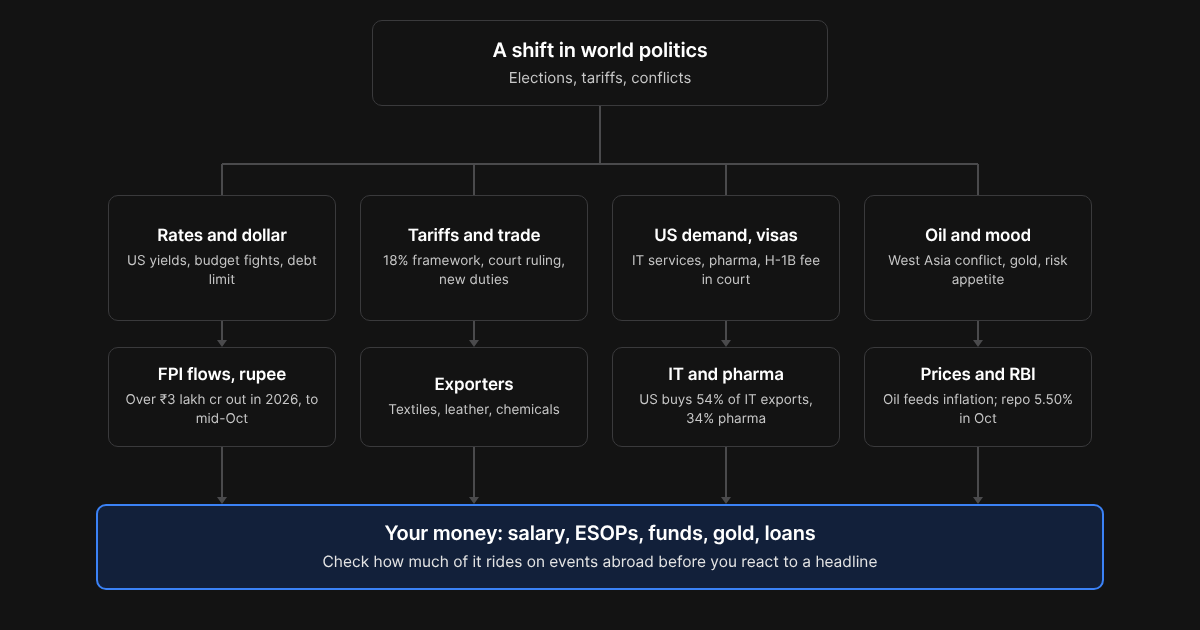
World politics shifted again this week: the US midterm elections changed which party controls Congress. Shifts like this reach the Indian stock market and economy through four channels: interest rates and the dollar, trade, US demand for Indian services and goods, and oil. You can’t control any of them. You can control how exposed your money is to each, and how you respond when the headlines get loud.
2026 has been a year of headlines. Tariffs changed more than once. A conflict in West Asia pushed oil past $100 a barrel. Foreign investors pulled record sums out of Indian shares. And this week, the US midterms changed the balance of power in Washington. Each time, the forwards arrive before breakfast: “Markets will crash.” “Sell IT.” “Buy gold now.”
Investing well in a shifting world isn’t about guessing what politicians will do next. It’s about knowing how politics reaches your money, and holding a portfolio that doesn’t need you to guess.
How world politics reaches the Indian market and economy
1. Interest rates, the dollar and foreign money
When US bonds pay more or the dollar strengthens, global money tends to stay in the US. This year foreign portfolio investors pulled a record of more than ₹3 lakh crore out of Indian shares by mid-October, nearly double their outflow for all of 2025 (Business Standard, NSDL data). In early October the rupee came within 12 paise of its record low of 96.96 to the dollar, set in May (Business Today), before recovering to 94.75 on 3 November (Business Standard).
For the economy, costlier fuel and food pushed retail inflation to 5.54% in September (MoSPI data, via Finnovate), and the RBI raised its repo rate to 5.50% in October, its first increase in nearly four years, citing food, fuel and the West Asia conflict (Business Standard). For you, rate decisions show up in floating-rate loan EMIs, in what new fixed deposits pay, and in the prices of bonds and debt funds.
2. Trade and tariffs
US trade policy has swung several times this year. In February an interim India-US framework cut the US tariff on Indian goods to 18% (India Briefing). Weeks later the US Supreme Court struck down the tariffs built on emergency powers, and a temporary 10% tariff on all trading partners took their place (Global Trade Alert). Since then, the US has moved to a more lasting structure under another trade law, according to ING (Fortune).
What the change in Washington means for trade is still open. Tanay Dalal, an economist at Axis Bank, says it could gradually narrow the room for new tariffs, and that easing tariffs would cool imported costs. He also says it doesn’t guarantee quick relief for Indian exporters, and that India could stay exposed to targeted trade measures (Business Today, 4 November). For investors, tariff news reaches exporters’ shares first, in sectors such as textiles, leather and chemicals.
3. US demand for Indian services, medicines and people
- IT services: the US bought 54.1% of India’s software services exports in 2025-26 (RBI survey, via NewsBytes).
- Pharma: about 34% of India’s medicine exports go to the US (Pharmexcil, via ChemIn Digest).
- Remittances: the US was the largest source of money sent home to India, 27.7% of the total in the RBI’s latest survey, for 2023-24 (The American Bazaar).
- Visas: the $100,000 fee on new H-1B petitions is blocked by US courts while the government appeals (University of Colorado Boulder).
These are some of India’s biggest earners of foreign exchange and employers of young graduates. They’re also where many portfolios hide a double bet: if your salary, your ESOPs and your equity funds all depend on US tech spending, you may own the same risk three times. On 4 November, IT was the main drag on an otherwise rising Indian market (HDFC Sky).
4. Oil and the global mood
India imports heavily, so oil prices feed straight into inflation, the rupee and interest rates here (Business Today). Brent crude was about $103 a barrel on 4 November, down from a six-month high of $118 on 30 October (HDFC Sky). Market watchers are now tracking whether the change in Washington affects West Asia tensions and energy prices (HDFC Sky).
Where India stands going in
India enters this stretch growing fast, with prices rising. In October the RBI raised its forecast for growth in 2026-27 to 7.1%, and its forecast for inflation to 5.2% (Business Standard). Markets have had a hard year: the Nifty 50 was down 14.4% by mid-October (Business Standard). Yet Indian investors kept going: monthly SIP inflows hit a record ₹32,490 crore in September (AMFI data, via IANS). And on 4 November, the day the US results came in, the Sensex and Nifty rose for a fifth straight session (HDFC Sky).
Seven habits for investing through political change
- Ask one question before you act. Has my goal, my timeline or my income changed? If not, a headline isn’t a reason to change your plan. Acting on news is expensive: in SEBI’s study of 2025-26, 87.7% of individual F&O traders in its sample made net losses, and individual traders lost ₹91,685 crore in all (Policy Edge).
- Map your exposure to the world. List where your money depends on events abroad: your job, ESOPs or RSUs, sector-heavy funds, international funds and any goal priced in dollars. A portfolio x-ray shows overlap and concentration across your funds in a few minutes.
- Price dollar goals in dollars. A child’s degree abroad or a family trip to the US costs more when the rupee weakens. Set the goal in dollars, convert it at today’s rate, add a buffer, and let a goal planner turn it into a monthly amount.
- Diversify on purpose. Spread money across shares, debt and gold, and across sectors, so no single political outcome decides your plan. Fix the mix in advance and rebalance on a schedule, not on a headline. If gold is part of the mix, know which gold you own.
- Keep a cash buffer. An emergency fund you can reach quickly, and money you need within a couple of years kept away from assets that can fall sharply, mean you never have to sell in a bad week. The nine-question money health score checks your safety net.
- Keep SIPs running, and count costs before any switch. A SIP is built to invest through ups and downs. Selling one fund to buy another can carry an exit load and capital gains tax, and regular plans pay a distributor commission every year (see what that costs).
- Check who’s advising you. Tips multiply in noisy weeks. Before acting on anyone’s advice, check that they are SEBI-registered (here’s how) and ask how they’re paid. A fee-only adviser earns no commission on anything you buy or sell (adviser or distributor?).
Three investors, three exposures
Made-up examples, not clients. The figures are illustrative. The securities quoted are for illustration only and are not recommendatory.
- Rohan, 36, an IT professional in Pune. His salary, his ESOPs and three of his seven equity funds all lean on US tech spending. His useful question isn’t “what will Washington do?” but “how much of my money rides on one sector?” His next step might be to stop adding to his most overlapping fund and to plan his ESOP sales in stages, with the tax in view.
- Meera and Arjun, saving for their daughter’s master’s in the US in 2031. Their goal is priced in dollars, so a weaker rupee makes it bigger. They might set it in dollars, add a currency buffer, and move the first year’s fees out of shares as the date nears.
- Mr Iyer, 67, retired, living on deposit interest and a debt fund. Higher rates mean new deposits pay more, but bond prices can dip when yields rise. His priority is cash for the next two years and a steady income plan, not the news cycle.
In each case, the answer comes from their own goals and risk profile, not from Washington. That is where a whole-portfolio review with a fee-only adviser starts.
Dates when the headlines will be loud
Mark them, then plan not to react to them:
- 2 to 4 December: the RBI’s next policy meeting (RBI)
- 8 to 9 December: the US Federal Reserve’s last meeting of the year (Federal Reserve)
- 11 December: US government funding runs out unless it’s extended (Fortune)
- Early February: India’s Union Budget, then the RBI’s February meeting (RBI)
Frequently asked questions
How do the US midterm results affect the Indian stock market?
Through US interest rates and the dollar, trade policy, US demand for Indian IT, pharma and workers, and oil. The effect depends on the policies that follow, not on the result itself, and Indian shares also move on company earnings, inflation and the RBI.
Should I stop my SIP when world politics turns uncertain?
If your goal, timeline and income haven’t changed, uncertainty abroad isn’t a reason to stop. A SIP is built to invest through ups and downs. If something in your own life has changed, review the plan with an adviser before you change the SIP.
How does a weaker rupee affect my investments and goals?
It makes imports such as oil costlier, which can push up inflation and interest rates. It also raises the rupee cost of goals priced in dollars, such as study abroad, and lifts the rupee value of investments held in dollars.
Which Indian sectors are most exposed to global politics?
IT services and pharma, because the US is their biggest market; exporters that face US tariffs, such as textiles, leather and chemicals; and businesses whose costs move with oil.
What role can gold play when politics is uncertain?
Gold often draws buyers in uncertain times, but its price can fall too, and what you pay to hold it depends on the form you buy. Decide its share of your portfolio in advance, rather than in a week of headlines.
How do I choose an investment adviser I can trust?
Check that the adviser is registered with SEBI, ask how they are paid, and expect them to look at everything you own, start with your risk profile and put advice in writing. Invsify’s SEBI registration number is INA000020572.
A plan built for change
World politics will keep shifting. A portfolio built for change needs fewer changes itself. If you’d like a SEBI-registered adviser who is paid only by you to look at where your money sits, the first call is free, with no obligation and nothing to buy. Or start on your own with the portfolio x-ray.
Sources
Markets and flows: HDFC Sky (close, 4 Nov 2026) and HDFC Sky (open, 4 Nov); Business Standard (13 Oct) and Business Standard (3 Nov); Business Today (7 Oct); Telangana Today (AMFI, 13 Oct); Policy Edge (SEBI study, 20 Aug). Economy: Business Standard (RBI policy, 7 Oct); Finnovate (MoSPI, 13 Oct); NewsBytes (RBI survey, 19 Sep); ChemIn Digest (Pharmexcil, 9 Apr); The American Bazaar (RBI survey, 15 Sep). Trade and policy: India Briefing (Feb 2026); Global Trade Alert (Feb 2026); Fortune (3 Nov); Business Today (4 Nov); University of Colorado Boulder (7 Oct). Calendars: RBI (23 Mar); Federal Reserve.
Disclosure
Invsify Technologies Private Limited is a SEBI-registered Investment Adviser, Registration No. INA000020572; BASL enlistment ID 2286; CIN U66190DL2025PTC444097. Registered office: F-33/3, 2nd Floor, Phase 2, Okhla Industrial Estate, New Delhi 110020. Principal Officer: Mohana Pradeesh T T. Compliance Officer: Vineet Parashar, +91 22 6933 1660, [email protected]. Grievances: [email protected], then SEBI SCORES and Smart ODR.
This article is for education only. It is not investment advice or a recommendation to buy, sell or hold any security, and it names no product. It takes no view on any party or candidate. Figures are as of the dates shown and can change.
Investment in securities market are subject to market risks. Read all the related documents carefully before investing.
Registration granted by SEBI, membership of BASL and certification from NISM in no way guarantee performance of the intermediary or provide any assurance of returns to investors.